| ID | 70915 |
| フルテキストURL | |
| 著者 |
Matsumoto, Kazuyuki
Gastroenterology and Hepatology, Okayama University Hospital
ORCID
Kaken ID
publons
Kato, Hironari
Gastroenterology and Hepatology, Okayama University Hospital
ORCID
Kaken ID
researchmap
Itoi, Takao
Gastroenterology and Hepatology, Tokyo Medical University
Kitano, Masayuki
Second Department of Internal Medicine, Wakayama Medical University
Hara, Kazuo
Gastroenterology, Aichi Cancer Center Hospital
Kuwatani, Masaki
Gastroenterology and Hepatology, Hokkaido University Hospital
Takenaka, Mamoru
Gastroenterology and Hepatology, Kindai University Faculty of Medicine Graduate School of Medical Sciences
Ashida, Reiko
Second Department of Internal Medicine, Wakayama Medical University
Mukai, Shuntaro
Gastroenterology and Hepatology, Tokyo Medical University
Okuno, Nozomi
Gastroenterology, Aichi Cancer Center Hospital
Kawakubo, Kazumichi
Gastroenterology and Hepatology, Hokkaido University Hospital
Yamazaki, Tatsuhiro
Gastroenterology and Hepatology, Okayama University Hospital
Sakurai, Jun
Center for Innovative Clinical Medicine, Okayama University Hospital
Nakatsuka, Yuki
Center for Innovative Clinical Medicine, Okayama University Hospital
Yoshida, Michihiro
Center for Innovative Clinical Medicine, Okayama University Hospital
Otsuka, Motoyuki
Gastroenterology and Hepatology, Okayama University Hospital
|
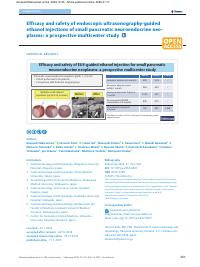
| 抄録 | Background Endoscopic ultrasonography (EUS)-guided ethanol injection (EI) has recently been introduced as one of the management strategies for pancreatic neuroendocrine neoplasms (PNENs); however, its role as a surgical alternative is unclear. We evaluated the efficacy and safety of EUS-EI in treating small PNENs through a prospective multicenter study.
Methods Patients with grade 1 tumors of ≤15 mm confirmed by pathology were included. The primary end point assessed efficacy and safety, measuring complete ablation using computed tomography at 1 and 6 months, prevention of adverse events (AEs) within 1 month, severe pancreatic fistula at 1 month, and incidence/worsening of diabetes mellitus (DM) at 6 months. The composite end point of EUS-EI was compared with that of historical results of a study based on surgical treatment. Results 25 patients with PNENs, with a median tumor size of 10.1 mm, were treated using EUS-EI. The composite primary end point was achieved by 76.0% of patients (19/25; 95%CI 54.9%–90.6%), a proportion significantly higher than that of surgical treatment (P = 0.008). Regarding efficacy, 88.0% (22/25) of patients achieved complete ablation at 1 and 6 months (95%CI 68.8%–97.5%). Regarding safety, 96.0% (24/25) of patients had no severe AEs within 1 month (95%CI 79.7%–99.9%). No patients had severe pancreatic fistulas at 1 month, and 84.0% (21/25) had no incidence or exacerbation, or both, of DM at 6 months (95%CI 63.9%–95.5%). Conclusion EUS-EI is safe and could be a potent treatment option for patients with small PNENs. |
| 発行日 | 2024-10-25
|
| 出版物タイトル |
Endoscopy
|
| 巻 | 57巻
|
| 号 | 04号
|
| 出版者 | Georg Thieme Verlag KG
|
| 開始ページ | 321
|
| 終了ページ | 329
|
| ISSN | 0013-726X
|
| NCID | AA00635110
|
| 資料タイプ |
学術雑誌論文
|
| 言語 |
英語
|
| OAI-PMH Set |
岡山大学
|
| 著作権者 | © 2025. The Author(s).
|
| 論文のバージョン | publisher
|
| PubMed ID | |
| DOI | |
| Web of Science KeyUT | |
| 関連URL | isVersionOf https://doi.org/10.1055/a-2452-4607
|
| ライセンス | https://creativecommons.org/licenses/by-nc-nd/4.0/
|
| 助成情報 |
( 公益財団法人内視鏡医学研究振興財団 / Japanese Foundation for Research and Promotion of Endoscopy )
|