| ID | 70073 |
| JaLCDOI | |
| FullText URL | |
| Author |
Akazawa, Hidemasa
Department of General Medicine, Okayama University Graduate School of Medicine, Dentistry and Pharmaceutical Sciences,
Hagiya, Hideharu
Department of Infectious Diseases, Okayama University Hospital
ORCID
Kaken ID
researchmap
Fukushima, Shinnosuke
Department of Infectious Diseases, Okayama University Hospital
Yamamoto, Shohei
Department of General Medicine, Okayama University Graduate School of Medicine, Dentistry and Pharmaceutical Sciences,
Nakano, Yasuhiro
Department of General Medicine, Okayama University Graduate School of Medicine, Dentistry and Pharmaceutical Sciences,
Otsuka, Fumio
Department of General Medicine, Okayama University Graduate School of Medicine, Dentistry and Pharmaceutical Sciences,
ORCID
Kaken ID
publons
researchmap
|
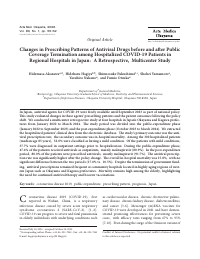
| Abstract | In Japan, antiviral agents for COVID-19 were freely available until September 2023 as part of national policy. This study evaluated changes in these agents’ prescribing patterns and the patient outcomes following the policy shift. We conducted a multicenter retrospective study at four hospitals in Japan’s Okayama and Kagawa prefectures from January 2022 to March 2024. The study period was divided into the public-expenditure phase (January 2022 to September 2023) and the post-expenditure phase (October 2023 to March 2024). We extracted the hospitalized patients’ clinical data from the electronic database. The study’s primary outcome was the antiviral prescription rate; the secondary outcome was in-hospital mortality. Among the 302 hospitalized patients (median age 85 years), 52.0% were classified as having a mild condition. Of the patients with mild conditions, 37.7% were diagnosed in outpatient settings prior to hospitalization. During the public-expenditure phase, 47.4% of the patients received antivirals as outpatients, mainly molnupiravir (80.9%). In the post-expenditure period, 80.0% of the patients were prescribed antivirals, mostly molnupiravir (91.7%). The antiviral prescription rate was significantly higher after the policy change. The overall in-hospital mortality was 15.8%, with no significant difference between the two periods (17.0% vs. 10.5%). Despite the termination of government funding, antiviral prescriptions remained frequent at community hospitals located in highly aging regions of western Japan such as Okayama and Kagawa prefectures. Mortality remains high among the elderly, highlighting the need for continued antiviral therapy and booster vaccinations.
|
| Keywords | coronavirus disease 2019
public expenditure
prescribing pattern
prognosis
Japan
|
| Amo Type | Original Article
|
| Publication Title |
Acta Medica Okayama
|
| Published Date | 2026-02
|
| Volume | volume80
|
| Issue | issue1
|
| Publisher | Okayama University Medical School
|
| Start Page | 55
|
| End Page | 62
|
| ISSN | 0386-300X
|
| NCID | AA00508441
|
| Content Type |
Journal Article
|
| language |
English
|
| Copyright Holders | Copyright Ⓒ 2026 by Okayama University Medical School
|
| File Version | publisher
|
| Refereed |
True
|
| PubMed ID | |
| Web of Science KeyUT |