| ID | 71066 |
| JaLCDOI | |
| FullText URL | |
| Author |
Ogawa, Sakura
Department of Infectious Diseases, Okayama University Graduate School of Medicine, Dentistry and Pharmaceutical Sciences
Fukushima, Shinnosuke
Department of Infectious Diseases, Okayama University Graduate School of Medicine, Dentistry and Pharmaceutical Sciences
Akazawa, Hidemasa
Department of Infectious Diseases, Okayama University Graduate School of Medicine, Dentistry and Pharmaceutical Sciences
Namba, Sachie
Department of Laboratory Testing, Okayama Medical Laboratory Center
Hirota, Chiyoko
Department of Laboratory Testing, Okayama Medical Laboratory Center
Kishiue, Tomoyoshi
Department of Laboratory Testing, Okayama Medical Laboratory Center
Ibara, Shohei
Department of Laboratory Testing, Okayama Medical Laboratory Center
Kondo, Takayuki
Department of Laboratory Testing, Okayama Medical Laboratory Center
Fukuda, Genshi
Department of Sales Promotion, Okayama Medical Laboratory Center
Iio, Koji
Microbiology Division, Clinical Laboratory, Okayama University Hospital
Tsuji, Shuma
Department of Medical Laboratory Science, Okayama University Graduate School of Health Sciences
Gotoh, Kazuyoshi
Department of Medical Laboratory Science, Okayama University Graduate School of Health Sciences
Otsuka, Fumio
Department of General Medicine, Okayama University Graduate School of Medicine, Dentistry and Pharmaceutical Sciences
ORCID
Kaken ID
publons
researchmap
Hagiya, Hideharu
Department of Infectious Diseases, Okayama University Graduate School of Medicine, Dentistry and Pharmaceutical Sciences
ORCID
Kaken ID
researchmap
|
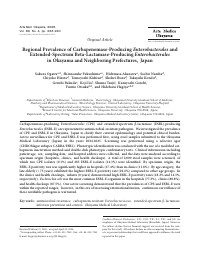
| Abstract | Carbapenemase-producing Enterobacterales (CPE) and extended-spectrum β-lactamase (ESBL)-producing Enterobacterales (ESBL-E) are representative antimicrobial-resistant pathogens. We investigated the prevalence of CPE and ESBL-E in Okayama, Japan to clarify their current epidemiology and potential clinical burden. Active surveillance for CPE and ESBL-E was performed first, using stool samples submitted to the Okayama Medical Laboratory (Japan) in the years 2024-2025. Screening was performed using a selective agar (CHROMagar mSuper CARBA/ESBL). Phenotypic identification was conducted with the use of a modified carbapenem inactivation method and double-disk phenotypic confirmatory tests. Clinical information including patient age, sex, sampling date, and hospital address were collected, and the data were analyzed according to specimen origin (hospitals, clinics, and health checkups). A total of 2,000 stool samples were screened, of which two CPE isolates (0.1%) and 285 ESBL-E isolates (14.3%) were identified. By specimen origin, the ESBL-E positivity rate was significantly higher in hospitals (17.4%) than in clinics (11.8%). By age category, the late elderly (> 75 years) exhibited the highest ESBL-E positivity rate (22.6%) compared to other age groups. In the clinics and health checkups, infants (0 years) demonstrated high ESBL-E positivity rates (18.2% and 14.3%, respectively). Escherichia coli was the most common ESBL-E organism in the hospitals (77.2%), clinics (88.8%), and health checkups (87.5%). Our active screening demonstrated that the prevalences of CPE and ESBL-E were within the reported ranges; however, in this era of increasing internationalization, continuous surveillance of these notifiable pathogens is warranted.
|
| Keywords | antimicrobial resistance
carbapenem-resistant Enterobacteriaceae
extended-spectrum β-lactamase
infection prevention and control
Okayama Medical Laboratory
|
| Amo Type | Original Article
|
| Publication Title |
Acta Medica Okayama
|
| Published Date | 2026-08
|
| Volume | volume80
|
| Issue | issue4
|
| Publisher | Okayama University Medical School
|
| Start Page | 233
|
| End Page | 240
|
| ISSN | 0386-300X
|
| NCID | AA00508441
|
| Content Type |
Journal Article
|
| language |
English
|
| Copyright Holders | Copyright Ⓒ 2026 by Okayama University Medical School
|
| File Version | publisher
|
| Refereed |
True
|