| ID | 70956 |
| フルテキストURL | |
| 著者 |
Otomo, Shiho
School of Environment and Society, Institute of Science Tokyo
Fujisaki, Maoko
School of Environment and Society, Institute of Science Tokyo
Yanagase, Risako
School of Environment and Society, Institute of Science Tokyo
Noritake, Kanako
Institute of Science Tokyo Hospital, Institute of Science Tokyo
Yanagi, Yoshinobu
Faculty of Medicine, Dentistry and Pharmaceutical Sciences, Okayama University
ORCID
Kaken ID
publons
researchmap
Sugihara, Taro
School of Environment and Society, Institute of Science Tokyo
|
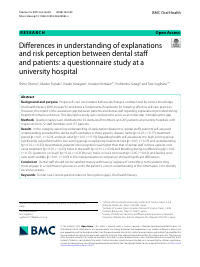
| 抄録 | Background and purpose: Proper self-care necessitates behavioral changes, underpinned by correct knowledge. Oral health literacy (OHL) research constitutes a fundamental foundation for fostering effective self-care practices. However, the extent of the awareness gap between patients and dental staff regarding explanations provided during treatment remains unknown. This descriptive study was conducted to serve as an initial step in bridging this gap.
Methods: Questionnaires were distributed to 92 dental staff members and 205 patients at university hospitals, with responses from 72 staff members and 157 patients. Results: In the category assessing understanding of explanations (patient vs. dental staff), patients’ self-assessed understanding exceeded the dental staff’s estimates in three aspects: disease name (p = 0.03, r = 0.17), treatment period (p = 0.01, r = 0.21), and pain relief (p = 0.01, r = 0.19). Regarding health self-awareness, the high-scoring group significantly outperformed the low-scoring group in explaining treatment risks (p = 0.03, r = 0.21) and understanding (p = 0.01, r = 0.23). Nevertheless, patients’ risk recognition was higher than that of dental staff in three aspects: root canal treatment (p < 0.01, r = 0.23), holes in the teeth (p < 0.01, r = 0.24), and bleeding during toothbrushing (p = 0.02, r = 0.17). Questions on “crack” (p = 0.02, r = 0.21) by sex, holes in one’s own teeth (p = 0.05, r = 0.03), and feeling one’s own teeth wobble (p < 0.01, r = 0.07) in the intergenerational comparison showed significant differences. Conclusion: Dental staff should not be satisfied merely with having "explained" something to the patient; they must engage in a confirmation process to verify the patient's correct understanding of the information or to identify excessive anxiety. |
| キーワード | Dental care
Dentist-patient relations
Recognition gaps
Oral health literacy
|
| 発行日 | 2026-04-23
|
| 出版物タイトル |
BMC Oral Health
|
| 巻 | 26巻
|
| 号 | 1号
|
| 出版者 | Springer Science and Business Media LLC
|
| 開始ページ | 1050
|
| ISSN | 1472-6831
|
| 資料タイプ |
学術雑誌論文
|
| 言語 |
英語
|
| OAI-PMH Set |
岡山大学
|
| 著作権者 | © The Author(s) 2026.
|
| 論文のバージョン | publisher
|
| PubMed ID | |
| DOI | |
| Web of Science KeyUT | |
| 関連URL | isVersionOf https://doi.org/10.1186/s12903-026-08363-x
|
| ライセンス | http://creativecommons.org/licenses/by-nc-nd/4.0/
|
| Citation | Otomo, S., Fujisaki, M., Yanagase, R. et al. Differences in understanding of explanations and risk perception between dental staff and patients: a questionnaire study at a university hospital. BMC Oral Health 26, 1050 (2026). https://doi.org/10.1186/s12903-026-08363-x
|
| 助成情報 |
22K12701:
歯科診療における患者の主体的な治療参加意欲を引き出すのためのデザイン研究
( 独立行政法人日本学術振興会 / Japan Society for the Promotion of Science )
|