| ID | 69124 |
| フルテキストURL | |
| 著者 |
Ho, Viet Hoang
Graduate School of Environmental and Life Science, Okayama University
Morita, Hidenori
Graduate School of Environmental, Life, Natural Science and Technology, Okayama University
Kaken ID
publons
researchmap
Ho, Thanh Ha
University of Agriculture and Forestry, Hue University
Bachofer, Felix
German Aerospace Center (DLR), Earth Observation Center
Nguyen, Thi Thuong
University of Agriculture and Forestry, Hue University
|
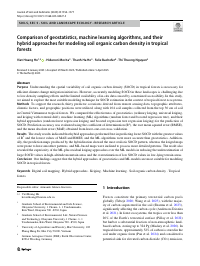
| 抄録 | Purpose Understanding the spatial variability of soil organic carbon density (SOCD) in tropical forests is necessary for efficient climate change mitigation initiatives. However, accurately modeling SOCD in these landscapes is challenging due to low-density sampling efforts and the limited availability of in-situ data caused by constrained accessibility. In this study, we aimed to explore the most suitable modeling technique for SOCD estimation in the context of tropical forest ecosystems.
Methods To support the research, thirty predictor covariates derived from remote sensing data, topographic attributes, climatic factors, and geographic positions were utilized, along with 104 soil samples collected from the top 30 cm of soil in Central Vietnamese tropical forests. We compared the effectiveness of geostatistics (ordinary kriging, universal kriging, and kriging with external drift), machine learning (ML) algorithms (random forest and boosted regression tree), and their hybrid approaches (random forest regression kriging and boosted regression tree regression kriging) for the prediction of SOCD. Prediction accuracy was evaluated using the coefficient of determination (R2), the root mean squared error (RMSE), and the mean absolute error (MAE) obtained from leave-one-out cross-validation. Results The study results indicated that hybrid approaches performed best in predicting forest SOCD with the greatest values of R2 and the lowest values of MAE and RMSE, and the ML algorithms were more accurate than geostatistics. Additionally, the prediction maps produced by the hybridization showed the most realistic SOCD pattern, whereas the kriged maps were prone to have smoother patterns, and ML-based maps were inclined to possess more detailed patterns. The result also revealed the superiority of the ML plus residual kriging approaches over the ML models in reducing the underestimation of large SOCD values in high-altitude mountain areas and the overestimation of low SOCD values in low-lying terrain areas. Conclusion Our findings suggest that the hybrid approaches of geostatistics and ML models are most suitable for modeling SOCD in tropical forests. |
| キーワード | Digital soil mapping
Hybrid approaches
Kriging
Machine learning
Soil organic carbon density
Tropical forests
|
| 備考 | The version of record of this article, first published in Journal of Soils and Sediments, is available online at Publisher’s website: http://dx.doi.org/10.1007/s11368-025-04027-5
|
| 発行日 | 2025-04-05
|
| 出版物タイトル |
Journal of Soils and Sediments
|
| 巻 | 25巻
|
| 号 | 5号
|
| 出版者 | Springer Science and Business Media LLC
|
| 開始ページ | 1554
|
| 終了ページ | 1577
|
| ISSN | 1439-0108
|
| 資料タイプ |
学術雑誌論文
|
| 言語 |
英語
|
| OAI-PMH Set |
岡山大学
|
| 著作権者 | © The Author(s) 2025
|
| 論文のバージョン | publisher
|
| DOI | |
| Web of Science KeyUT | |
| 関連URL | isVersionOf https://doi.org/10.1007/s11368-025-04027-5
|
| ライセンス | http://creativecommons.org/licenses/by/4.0/
|
| Citation | Ho, V.H., Morita, H., Ho, T.H. et al. Comparison of geostatistics, machine learning algorithms, and their hybrid approaches for modeling soil organic carbon density in tropical forests. J Soils Sediments 25, 1554–1577 (2025). https://doi.org/10.1007/s11368-025-04027-5
|
| 助成情報 |
( 国立大学法人岡山大学 / Okayama University )
|