| ID | 68945 |
| フルテキストURL | |
| 著者 |
Hiejima, Shoma
The United Graduate School of Agricultural Sciences, Kagoshima University
Seino, Hiroto
Graduate School of Agriculture, Forestry and Fisheries, Kagoshima University
Hachisuka, Rico
The United Graduate School of Agricultural Sciences, Kagoshima University
Watanabe, Yuka
Graduate School of Agriculture, Forestry and Fisheries, Kagoshima University
Matsuura, Takakazu
Institute of Plant Science and Resources, Okayama University
Mori, Izumi C.
Institute of Plant Science and Resources, Okayama University
Ugawa, Shin
The United Graduate School of Agricultural Sciences, Kagoshima University
|
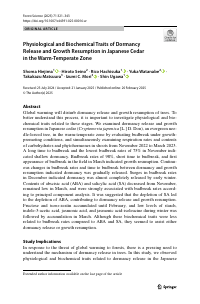
| 抄録 | Global warming will disturb dormancy release and growth resumption of trees. To better understand this process, it is important to investigate physiological and biochemical traits related to these stages. We examined dormancy release and growth resumption in Japanese cedar (Cryptomeria japonica [L.] D. Don), an evergreen needle-leaved tree, in the warm-temperate zone by evaluating budbreak under growth-promoting conditions, and simultaneously examining respiration rates and contents of carbohydrates and phytohormones in shoots from November 2022 to March 2023. A long time to budbreak and the lowest budbreak rates of 75% in November indicated shallow dormancy. Budbreak rates of 98%, short time to budbreak, and first appearance of budbreak in the field in March indicated growth resumption. Continuous changes in budbreak rates and time to budbreak between dormancy and growth resumption indicated dormancy was gradually released. Surges in budbreak rates in December indicated dormancy was almost completely released by early winter. Contents of abscisic acid (ABA) and salicylic acid (SA) decreased from November, remained low in March, and were strongly associated with budbreak rates according to principal component analysis. It was suggested that the depletion of SA led to the depletion of ABA, contributing to dormancy release and growth resumption. Fructose and trans-zeatin accumulated until February, and low levels of starch, indole-3-acetic acid, jasmonic acid, and jasmonic acid-isoleucine during winter was followed by accumulation in March. Although these biochemical traits were less related to budbreak rates compared to ABA and SA, they seemed to assist either dormancy release or growth resumption.
|
| キーワード | Japanese cedar
Warm-temperate zone
Dormancy release
Growth resumption
Physio-biochemical traits
|
| 備考 | The version of record of this article, first published in Forest Science, is available online at Publisher’s website: http://dx.doi.org/10.1007/s44391-025-00016-w
|
| 発行日 | 2025-02-20
|
| 出版物タイトル |
Forest Science
|
| 巻 | 71巻
|
| 号 | 3号
|
| 出版者 | Springer Science and Business Media LLC
|
| 開始ページ | 321
|
| 終了ページ | 343
|
| ISSN | 0015-749X
|
| NCID | AA00649782
|
| 資料タイプ |
学術雑誌論文
|
| 言語 |
英語
|
| OAI-PMH Set |
岡山大学
|
| 著作権者 | © The Author(s) 2025
|
| 論文のバージョン | publisher
|
| DOI | |
| Web of Science KeyUT | |
| 関連URL | isVersionOf https://doi.org/10.1007/s44391-025-00016-w
|
| ライセンス | http://creativecommons.org/licenses/by/4.0/
|
| Citation | Hiejima, S., Seino, H., Hachisuka, R. et al. Physiological and Biochemical Traits of Dormancy Release and Growth Resumption in Japanese Cedar in the Warm-Temperate Zone. For. Sci. 71, 321–343 (2025). https://doi.org/10.1007/s44391-025-00016-w
|
| 助成情報 |
( 国立大学法人鹿児島大学 / Kagoshima University )
|