| ID | 70928 |
| フルテキストURL | |
| 著者 |
Liu, Kang
Laboratory of Pharmacology, Division of Pathological Sciences, Kyoto Pharmaceutical University
Katayama, Tomoaki
Division of Pharmaceutical Sciences, Okayama University Graduate School of Medicine, Dentistry, and Pharmaceutical Sciences
Sato, Hitomi
Division of Pharmaceutical Sciences, Okayama University Graduate School of Medicine, Dentistry, and Pharmaceutical Sciences
Hamaoka-Tamura, Yuho
Laboratory of Pharmacology, Division of Pathological Sciences, Kyoto Pharmaceutical University
Saito, Michiko
Bioscience Research Center, Kyoto Pharmaceutical University
Furuta, Kazuyuki
Division of Pharmaceutical Sciences, Okayama University Graduate School of Medicine, Dentistry, and Pharmaceutical Sciences
Tanaka, Satoshi
Laboratory of Pharmacology, Division of Pathological Sciences, Kyoto Pharmaceutical University
|
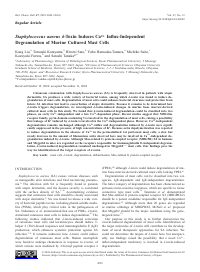
| 抄録 | Cutaneous colonization with Staphylococcus aureus (SA) is frequently observed in patients with atopic dermatitis. SA produces a wide variety of bacterial toxins, among which δ-toxin was found to induce degranulation of mast cells. Degranulation of mast cells could enhance bacterial clearance and protection from future SA infection but lead to exacerbation of atopic dermatitis. Because it remains to be determined how δ-toxin triggers degranulation, we investigated δ-toxin-induced changes in murine bone marrow-derived cultured mast cells in this study. We found that δ-toxin-induced degranulation could be classified into two phases, an early Ca2+-independent and a late Ca2+-dependent phase. Recent studies suggest that NOD-like receptor family, pyrin domain containing 3 is involved in the degranulation of mast cells, raising a possibility that leakage of K+ induced by δ-toxin is involved in the Ca2+-independent phase. However, Ca2+-independent degranulation remains unchanged although Ca2+-influx and degranulation induced by δ-toxin were significantly suppressed in the presence of high concentrations of K+. Because actin depolymerization was reported to induce degranulation in the absence of Ca2+ in the permeabilized rat peritoneal mast cells, a slow but steady decrease in the amount of filamentous actin observed here may be involved in Ca2+-independent degranulation induced by δ-toxin. Although Mas-related G protein-coupled receptor (MRGPR) X2 in humans and Mrgprb2 in mice are regarded as the receptors responsible for immunoglobulin E-independent degranulation, δ-toxin-induced degranulation remained unchanged in Mrgprb2−/− mast cells. Our findings pave the way for identification of the target receptors of δ-toxin.
|
| キーワード | mast cell
δ-toxin
degranulation
inflammation
Mas-related G protein-coupled receptor
|
| 発行日 | 2024-12-13
|
| 出版物タイトル |
Biological and Pharmaceutical Bulletin
|
| 巻 | 47巻
|
| 号 | 12号
|
| 出版者 | Pharmaceutical Society of Japan
|
| 開始ページ | 2058
|
| 終了ページ | 2064
|
| ISSN | 0918-6158
|
| NCID | AA10885497
|
| 資料タイプ |
学術雑誌論文
|
| 言語 |
英語
|
| OAI-PMH Set |
岡山大学
|
| 著作権者 | © 2024 Author(s)
|
| 論文のバージョン | publisher
|
| PubMed ID | |
| DOI | |
| Web of Science KeyUT | |
| 関連URL | isVersionOf https://doi.org/10.1248/bpb.b24-00689
|
| ライセンス | https://creativecommons.org/licenses/by-nc/4.0/
|
| 助成情報 |
26670029:
新たな創薬標的としての脳内マスト細胞
( 独立行政法人日本学術振興会 / Japan Society for the Promotion of Science )
16K08231:
IgE非依存的なマスト細胞活性化機構
( 独立行政法人日本学術振興会 / Japan Society for the Promotion of Science )
|