| ID | 70451 |
| JaLCDOI | |
| フルテキストURL | |
| 著者 |
Shiba, Takahiko
Department of Periodontology, Graduate School of Medical and Dental Sciences, Institute of Science Tokyo
Takamori, Mitsuhito
Department of Oral Physiology, Graduate School of Graduate School of Medicine, Dentistry and Pharmaceutical Sciences, Okayama University
Katagiri, Sayaka
Department of Oral Biology, Graduate School of Medical and Dental Sciences, Institute of Science Tokyo
Kobayashi, Ryota
Department of Periodontology, Graduate School of Medical and Dental Sciences, Institute of Science Tokyo
Kawauchi, Aki
Department of Dental Anesthesiology, Graduate School of Medical and Dental Sciences, Institute of Science Tokyo
Ohsugi, Yujin
Department of Oral Biology, Graduate School of Medical and Dental Sciences, Institute of Science Tokyo
Lin, Peiya
Department of Oral Biology, Graduate School of Medical and Dental Sciences, Institute of Science Tokyo
Ekuni, Daisuke
Department of Preventive Dentistry, Faculty of Medicine, Dentistry and Pharmaceutical Sciences, Okayama University
ORCID
Kaken ID
publons
researchmap
Egusa, Masahiko
The center for Special Needs Dentistry, Medical Development Field, Okayama University
Iwata, Takanori
Department of Periodontology, Graduate School of Medical and Dental Sciences, Institute of Science Tokyo
Maeda, Shigeru
Department of Dental Anesthesiology, Graduate School of Medical and Dental Sciences, Institute of Science Tokyo
|
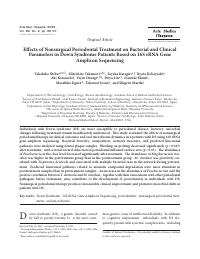
| 抄録 | Individuals with Down syndrome (DS) are more susceptible to periodontal disease; however, microbial changes following treatment remain insufficiently understood. This study evaluated the effects of nonsurgical periodontal therapy on clinical outcomes and oral microbiome dynamics in 6 patients with DS using 16S rRNA gene amplicon sequencing. Bacterial diversity, composition, network structure, and predicted functional pathways were analyzed using dental plaque samples. Bleeding on probing decreased significantly (p=0.047) after treatment, with a trend toward reduction in periodontal inflamed surface area (p=0.05). The abundance of Fusobacteria at the class level decreased significantly after treatment. The abundance of Mogibacterium timidum was higher in the pretreatment group than in the posttreatment group. M. timidum was positively correlated with Treponema denticola and associated with multiple bacterial taxa in the network during pretreatment. Predicted functional pathways related to aromatic compound degradation were more abundant in posttreatment samples than in pretreatment samples. An increase in the abundance of Fusobacterium and the positive correlation between T. denticola and M. timidum, together with their associations with other periodontal pathogens before treatment, may contribute to the development of periodontitis in individuals with DS. Nonsurgical periodontal therapy produces measurable clinical improvement and promotes microbial shifts in patients with DS.
|
| キーワード | Down Syndrome
16S rRNA Gene Amplicon Sequencing
periodontitis
nonsurgical periodontal treatment
oral microbiome
|
| Amo Type | Original Article
|
| 出版物タイトル |
Acta Medica Okayama
|
| 発行日 | 2026-04
|
| 巻 | 80巻
|
| 号 | 2号
|
| 出版者 | Okayama University Medical School
|
| 開始ページ | 85
|
| 終了ページ | 97
|
| ISSN | 0386-300X
|
| NCID | AA00508441
|
| 資料タイプ |
学術雑誌論文
|
| 言語 |
英語
|
| 著作権者 | Copyright Ⓒ 2026 by Okayama University Medical School
|
| 論文のバージョン | publisher
|
| 査読 |
有り
|