| ID | 70444 |
| フルテキストURL | |
| 著者 |
Ueta, Shiho
Department of Clinical Pharmacology and Therapeutics, University of Tokushima Graduate School of Biomedical Sciences
Niimura, Takahiro
Department of Clinical Pharmacology and Therapeutics, University of Tokushima Graduate School of Biomedical Sciences
Goda, Mitsuhiro
Department of Clinical Pharmacology and Therapeutics, University of Tokushima Graduate School of Biomedical Sciences
Ishida, Tomoaki
Department of Clinical Pharmacy, Graduate School of Pharmaceutical Sciences, Nagoya City University
Iwata, Naohiro
Department of Pharmacy, Okayama University Hospital
Kawada, Kei
Department of Clinical Pharmacology and Therapeutics, University of Tokushima Graduate School of Biomedical Sciences
Miyata, Koji
Department of Clinical Pharmacology and Therapeutics, University of Tokushima Graduate School of Biomedical Sciences
Aizawa, Fuka
Department of Clinical Pharmacology and Therapeutics, University of Tokushima Graduate School of Biomedical Sciences
Yagi, Kenta
Department of Clinical Pharmacology and Therapeutics, University of Tokushima Graduate School of Biomedical Sciences
Hamano, Hirofumi
Department of Pharmacy, Okayama University Hospital
Chuma, Masayuki
Department of Hospital Pharmacy and Pharmacology, Asahikawa Medical University
Izawa‐Ishizawa, Yuki
Department of Clinical Pharmacology and Therapeutics, University of Tokushima Graduate School of Biomedical Sciences
Zamami, Yoshito
Department of Pharmacy, Okayama University Hospital
ORCID
Kaken ID
publons
researchmap
Ishizawa, Keisuke
Department of Clinical Pharmacology and Therapeutics, University of Tokushima Graduate School of Biomedical Sciences
|
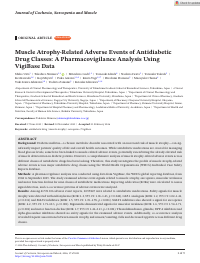
| 抄録 | Background: Diabetes mellitus—a chronic metabolic disorder associated with an increased risk of muscle atrophy—can significantly impact patients' quality of life and overall health outcomes. While antidiabetic medications are crucial for managing blood glucose levels, some have been linked to muscle-related adverse events, potentially exacerbating the already elevated risk of muscle deterioration in diabetic patients. However, a comprehensive analysis of muscle atrophy-related adverse events across different classes of antidiabetic drugs has been lacking. Therefore, this study investigates the profile of muscle atrophy-related adverse events across major antidiabetic drug classes using the World Health Organization's (WHO's) Individual Case Safety Reports database.
Methods: A pharmacovigilance analysis was conducted using data from VigiBase, the WHO's global reporting database, from 1968 to September 2025. The study examined adverse event signals related to muscle atrophy, sarcopenia, muscular weakness and motor function decline for nine classes of antidiabetic medications. Reporting odds ratios (RORs) were calculated to assess signal detection, and co-occurrence patterns of adverse events were analysed. Results: Among 41 551 306 adverse event reports, 2 095 847 were related to antidiabetic medications. Safety signals for muscle atrophy were detected with sulfonylureas (ROR: 1.2, 95% CI: 1.01–1.43, p = 0.042), GLP-1 analogues (ROR: 1.2, 95% CI: 1.02–1.41, p = 0.031) and SGLT2 inhibitors (ROR: 1.5, 95% CI: 1.19–1.78, p < 0.001). SGLT2 inhibitors also showed a signal for sarcopenia (ROR: 6.2, 95% CI: 3.71–10.3, p < 0.001). Biguanides demonstrated signals for muscular weakness (ROR: 1.6, 95% CI: 1.54–1.71, p < 0.001) and motor function decline (ROR: 1.7, 95% CI: 1.41–2.13, p < 0.001). Thiazolidinediones, glinides, DPP-4 inhibitors and alpha-glucosidase inhibitors showed no safety signals for the examined adverse events. Additionally, co-occurrence analysis revealed frequent associations between muscle atrophy and nausea/vomiting, falls and decreased appetite across different drug classes. Conclusions: These findings indicate notable differences in the profiles of muscle atrophy–related adverse events among major classes of antidiabetic drugs, suggesting that drug selection may influence the risk of muscle function decline in patients. Clinicians should consider these safety profiles when prescribing antidiabetic therapies; however, causal relationships cannot be inferred solely from pharmacovigilance data. Further studies are warranted to establish causality between antidiabetic drug use and muscle-related adverse events and to elucidate the underlying mechanisms. |
| キーワード | antidiabetic drug
muscle atrophy
sarcopenia
VigiBase
|
| 発行日 | 2026-04
|
| 出版物タイトル |
Journal of Cachexia, Sarcopenia and Muscle
|
| 巻 | 17巻
|
| 号 | 2号
|
| 出版者 | Wiley
|
| 開始ページ | e70251
|
| ISSN | 2190-5991
|
| 資料タイプ |
学術雑誌論文
|
| 言語 |
英語
|
| OAI-PMH Set |
岡山大学
|
| 著作権者 | © 2026 The Author(s).
|
| 論文のバージョン | publisher
|
| PubMed ID | |
| DOI | |
| 関連URL | isVersionOf https://doi.org/10.1002/jcsm.70251
|
| ライセンス | http://creativecommons.org/licenses/by/4.0/|http://doi.wiley.com/10.1002/tdm_license_1.1
|
| Citation | S.Ueta, T.Niimura, M.Goda, et al., “Muscle Atrophy-Related Adverse Events of Antidiabetic Drug Classes: A Pharmacovigilance Analysis Using VigiBase Data,” Journal of Cachexia, Sarcopenia and Muscle17, no. 2 (2026): e70251, https://doi.org/10.1002/jcsm.70251.
|
| 助成情報 |
JPMJSP2113:
( 国立研究開発法人科学技術振興機構 / Japan Science and Technology Agency )
|