| ID | 61492 |
| フルテキストURL | |
| 著者 |
Akezaki, Yoshiteru
Division of Physical Therapy, Kochi Professional University of Rehabilitation
Nakata, Eiji
Department of Orthopaedic Surgery, Okayama University Hospital
Kikuuchi, Masato
Department of Rehabilitation Medicine, National Hospital Organization Shikoku Cancer Center
Tominaga, Ritsuko
Department of Rehabilitation Medicine, National Hospital Organization Shikoku Cancer Center
Kurokawa, Hideaki
Department of Rehabilitation Medicine, National Hospital Organization Shikoku Cancer Center
Okamoto, Masaki
Department of Rehabilitation Medicine, National Hospital Organization Shikoku Cancer Center
Hamada, Makiko
Department of Rehabilitation Medicine, National Hospital Organization Shikoku Cancer Center
Aogi, Kenjiro
Department of Breast Oncology, National Hospital Organization Shikoku Cancer Center
Ohsumi, Shozo
Department of Breast Oncology, National Hospital Organization Shikoku Cancer Center
Sugihara, Shinsuke
Department of Rehabilitation Medicine, National Hospital Organization Shikoku Cancer Center
|
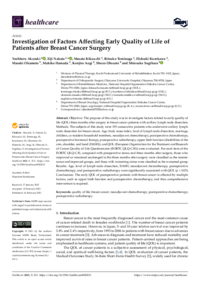
| 抄録 | Objective: The purpose of this study was to investigate factors related to early quality of life (QOL) three months after surgery in breast cancer patients with axillary lymph node dissection. Methods: The subjects of this study were 195 consecutive patients who underwent axillary lymph node dissection for breast cancer. Age, body mass index, level of lymph node dissection, marriage, children, co-resident household members, neoadjuvant chemotherapy, postoperative chemotherapy, postoperative hormonal therapy, postoperative radiotherapy, upper limb function (disabilities of the arm, shoulder, and hand (DASH)), and QOL (European Organization for the Treatment and Research of Cancer Quality of Life Questionnaire (EORTC QLQ-C30)) were evaluated. For each item of the EORTC QLQ-C30, compared with preoperative status and three months after surgery, those who improved or remained unchanged in the three months after surgery were classified as the maintenance and improved groups, and those with worsening status were classified as the worsened group. Results: Age, level of lymph node dissection, DASH, neoadjuvant chemotherapy, postoperative chemotherapy, and postoperative radiotherapy were significantly associated with QOL (p < 0.05). Conclusions: The early QOL of postoperative patients with breast cancer is affected by multiple factors, such as upper limb function and postoperative chemotherapy, and thus comprehensive intervention is required.
|
| キーワード | quality of life
breast cancer
neoadjuvant chemotherapy
postoperative chemotherapy
postoperative radiotherapy
|
| 発行日 | 2021-02-16
|
| 出版物タイトル |
Healthcare
|
| 巻 | 9巻
|
| 号 | 2号
|
| 出版者 | MDPI
|
| 開始ページ | 213
|
| ISSN | 2227-9032
|
| 資料タイプ |
学術雑誌論文
|
| 言語 |
英語
|
| OAI-PMH Set |
岡山大学
|
| 著作権者 | © 2021 by the authors.
|
| 論文のバージョン | publisher
|
| PubMed ID | |
| DOI | |
| Web of Science KeyUT | |
| 関連URL | isVersionOf https://doi.org/10.3390/healthcare9020213
|
| ライセンス | http://creativecommons.org/licenses/by/4.0/
|