| ID | 64360 |
| JaLCDOI | |
| フルテキストURL | |
| 著者 |
Yamanouchi, Kosho
Department of Surgery, National Hospital Organization, Nagasaki Medical Center
Maeda, Shigeto
Department of Surgery, National Hospital Organization, Nagasaki Medical Center
|
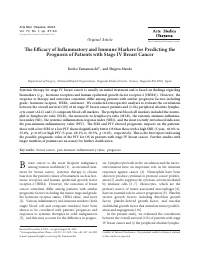
| 抄録 | Systemic therapy for stage IV breast cancer is usually an initial treatment and is based on findings regarding biomarkers (e.g., hormone receptors and human epidermal growth factor receptor-2 [HER2]). However, the response to therapy and outcomes sometime differ among patients with similar prognostic factors including grade, hormone receptor, HER2, and more. We conducted retrospective analyses to evaluate the correlations between the overall survival (OS) of 46 stage IV breast cancer patients and (i) the peripheral absolute lymphocyte count (ALC) and (ii) composite blood cell markers. The peripheral blood cell markers included the neutrophil- to-lymphocyte ratio (NLR), the monocyte-to-lymphocyte ratio (MLR), the systemic immune-inflammation index (SII), the systemic inflammation response index (SIRI), and the most recently introduced indicator, the pan-immune-inflammatory value (PIV). The SIRI and PIV showed prognostic impacts on the patients: those with a low SIRI or a low PIV showed significantly better OS than those with a high SIRI (5-year, 66.0% vs. 35.0%, p<0.05) or high PIV (5-year, 68.1% vs. 38.5%, p<0.05), respectively. This is the first report indicating the possible prognostic value of the PIV for OS in patients with stage IV breast cancer. Further studies with larger numbers of patients are necessary for further clarification.
|
| キーワード | breast cancer
pan-immune-inflammatory value
prognosis
|
| Amo Type | Original Article
|
| 出版物タイトル |
Acta Medica Okayama
|
| 発行日 | 2023-02
|
| 巻 | 77巻
|
| 号 | 1号
|
| 出版者 | Okayama University Medical School
|
| 開始ページ | 37
|
| 終了ページ | 43
|
| ISSN | 0386-300X
|
| NCID | AA00508441
|
| 資料タイプ |
学術雑誌論文
|
| 言語 |
英語
|
| 著作権者 | Copyright Ⓒ 2023 by Okayama University Medical School
|
| 論文のバージョン | publisher
|
| 査読 |
有り
|
| PubMed ID | |
| Web of Science KeyUT |