| ID | 69197 |
| フルテキストURL | |
| 著者 |
Tomimoto, Syouta
Department of Radiological Technology, Faculty of Medicine, Graduate School of Health Sciences, Okayama University
Saeki, Yusuke
Department of Radiological Technology, Kawasaki Medical School Hospital
Motoda, Okihiro
Department of Radiological Technology, Kawasaki Medical School Hospital
Tanaka, Masato
Department of Radiological Technology, Kawasaki Medical School Hospital
Tsumoto, Syouki
Department of Radiological Technology, Faculty of Medicine, Graduate School of Health Sciences, Okayama University
Nishikawa, Hana
Department of Radiological Technology, Faculty of Medicine, Graduate School of Health Sciences, Okayama University
Miyashima, Yuki
Department of Radiological Technology, Kawasaki Medical School Hospital
Higuchi, Makiko
Department of Radiological Technology, Kawasaki Medical School Hospital
Tani, Tadashi
Department of Radiological Technology, Kawasaki Medical School Hospital
Katsui, Kuniaki
Department of Radiology, Kawasaki Medical School
Tanabe, Yoshinori
Department of Radiological Technology, Faculty of Medicine, Graduate School of Health Sciences, Okayama University
ORCID
Kaken ID
researchmap
|
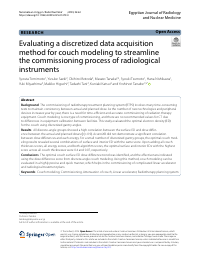
| 抄録 | Background The commissioning of radiotherapy treatment planning system (RTPS) involves many time-consuming tests to maintain consistency between actual and planned dose. As the number of new technologies and peripheral devices increases year by year, there is a need for time-efficient and accurate commissioning of radiation therapy equipment. Couch modeling is one type of commissioning, and there are no recommended values for CT due to differences in equipment calibration between facilities. This study evaluated the optimal electron density (ED) for the couch using discretized gantry angles.
Results All discrete-angle groups showed a high correlation between the surface ED and dose difference between the actual and planned doses (|r|> 0.9). AcurosXB did not demonstrate a significant correlation between dose differences and each energy. For a small number of discretized gantry groups, the optimal couch modeling results revealed several combinations of surface and interior ED with the same score. Upon adding all couch thickness scores, all energy scores, and both algorithm scores, the optimal surface and interior EDs with the highest score across all couch thicknesses were 0.4 and 0.07, respectively. Conclusions The optimal couch surface ED dose difference trend was identified, and the effectiveness indicated using the dose difference score from discrete-angle couch modeling. Using this method, couch modeling can be evaluated in a highly precise and quick manner, which helps in the commissioning of complicated linear accelerator and radiological treatment plans. |
| キーワード | Couch modeling
Commissioning
Attenuation of couch
Linear accelerator
Radiotherapy planning system
|
| 発行日 | 2025-05-27
|
| 出版物タイトル |
Egyptian Journal of Radiology and Nuclear Medicine
|
| 巻 | 56巻
|
| 号 | 1号
|
| 出版者 | Springer Science and Business Media LLC
|
| 開始ページ | 64
|
| ISSN | 2090-4762
|
| 資料タイプ |
学術雑誌論文
|
| 言語 |
英語
|
| OAI-PMH Set |
岡山大学
|
| 著作権者 | © The Author(s) 2025.
|
| 論文のバージョン | publisher
|
| DOI | |
| Web of Science KeyUT | |
| 関連URL | isVersionOf https://doi.org/10.1186/s43055-025-01479-0
|
| ライセンス | http://creativecommons.org/licenses/by/4.0/
|
| Citation | Tomimoto, S., Saeki, Y., Motoda, O. et al. Evaluating a discretized data acquisition method for couch modeling to streamline the commissioning process of radiological instruments. Egypt J Radiol Nucl Med 56, 64 (2025). https://doi.org/10.1186/s43055-025-01479-0
|
| 助成情報 |
23K07063:
位相幾何学特徴値を用いた堅固な前立腺強度変調放射線治療法の開発
( 独立行政法人日本学術振興会 / Japan Society for the Promotion of Science )
|