| ID | 70868 |
| フルテキストURL | |
| 著者 |
Rowe, M.C.
School of Environment, University of Auckland
Campbell, K.A.
School of Environment, University of Auckland
Stallard, D.A.
School of Environment, University of Auckland
Lyon, B.
School of Environment, University of Auckland
Langendam, A.
Australian Synchrotron Facility (Ansto)
Kalinina, E.
The Pheasant Memorial Laboratory for Geochemistry and Cosmochemistry, Institute for Planetary Materials, Okayama University
Yamanaka, M.
The Pheasant Memorial Laboratory for Geochemistry and Cosmochemistry, Institute for Planetary Materials, Okayama University
Tanaka, R.
The Pheasant Memorial Laboratory for Geochemistry and Cosmochemistry, Institute for Planetary Materials, Okayama University
Christopher, T.
School of Chemical Sciences, University of Auckland
Ruff, S.W.
Arizona State University, School of Earth And Space Exploration
Nersezova, E.
School of Environment, University of Auckland
Ota, T.
The Pheasant Memorial Laboratory for Geochemistry and Cosmochemistry, Institute for Planetary Materials, Okayama University
Hamilton, A.
School of Environment, University of Auckland
|
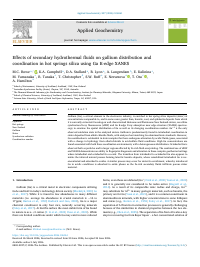
| 抄録 | Gallium (Ga), a critical element in the electronics industry, is enriched in hot spring silica deposits (sinter) at concentrations comparable to, and in some cases greater than, bauxite, coal, and sphalerite deposits from which it is currently extracted. Focusing on well characterized Holocene and Pleistocene New Zealand sinters, we utilize synchrotron-X-ray fluorescence (sXRF) and Ga K-edge X-ray absorption near edge structure (XANES) spectroscopy to examine the spatial distribution of Ga as well as its changing coordination number. Ga+3 is the only observed oxidation state in the analyzed sinters. Gallium is predominantly found in tetrahedral coordination in sinter deposited from alkali chloride fluids, with analyses best matching Ga-aluminosilicate standards. However, Ga coordination is octahedral in sinter samples that have undergone alteration by acidic fluids/gases, associated with a change in hydrology from alkali-chloride to acid-sulfate fluid conditions. High Ga concentrations are found associated with both these coordination environments, with a heterogeneous distribution. Octahedral Ga is observed both as particles and in larger regions affected by Fe-rich fluid overprinting. The combined use of sXRF and XANES demonstrates an ability to fingerprint diagenesis and alteration in these complex geothermal settings where tetrahedral and octahedral Ga co-exist. The transition from tetrahedral to octahedral Ga also appears to mimic the inferred natural process forming lateritic bauxite deposits, where remobilized tetrahedral Ga is reconcentrated and adsorbed to oxides. A similar process may occur for sinter Ga enrichment, whereby introduced Ga in acidic conditions is adsorbed to oxide phases as the Fe-rich secondary fluids infiltrate porous sinter material.
|
| キーワード | Hot springs
New Zealand
Gallium
Sinter
Synchrotron radiation
Coordination number
|
| 発行日 | 2026-09
|
| 出版物タイトル |
Applied Geochemistry
|
| 巻 | 207巻
|
| 出版者 | Elsevier BV
|
| 開始ページ | 106961
|
| ISSN | 0883-2927
|
| NCID | AA10681191
|
| 資料タイプ |
学術雑誌論文
|
| 言語 |
英語
|
| OAI-PMH Set |
岡山大学
|
| 著作権者 | © 2026 The Authors.
|
| 論文のバージョン | publisher
|
| DOI | |
| 関連URL | isVersionOf https://doi.org/10.1016/j.apgeochem.2026.106961
|
| ライセンス | http://creativecommons.org/licenses/by/4.0/
|
| 助成情報 |
24-UOA-206:
( RSNZ )
|