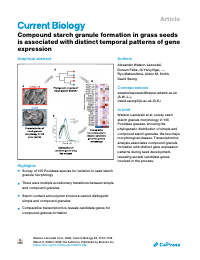
Compound starch granule formation in grass seeds is associated with distinct temporal patterns of gene expression
Permalink : https://ousar.lib.okayama-u.ac.jp/70885
| フルテキストURL | |
| 著者 |
Watson-Lazowski, Alexander
John Innes Centre, Norwich Research Park
Feike, Doreen
John Innes Centre, Norwich Research Park
Ngai, Qi Yang
John Innes Centre, Norwich Research Park
Esch, Lara
John Innes Centre, Norwich Research Park
Fujita, Naoko
Department of Biological Production, Akita Prefectural University
Matsushima, Ryo
Institute of Plant Science and Resources, Okayama University
Kaken ID
publons
researchmap
Smith, Alison M.
John Innes Centre, Norwich Research Park
Seung, David
John Innes Centre, Norwich Research Park
|
| 抄録 | There is extensive interspecies variation in starch granule morphology in the endosperm of grass species, but the factors underpinning this variation are poorly understood. The two major granule morphology types among species are simple and compound granules, where simple granules arise from a single initiation per amyloplast, and compound granules form from multiple granule initiations. Here, we carried out an extensive survey of seed starch morphology, examining specimens from 105 species within the Pooideae using electron microscopy. This not only expanded our current knowledge of the diversity of starch granule types but also confirmed the homoplasy of simple and compound starch granules. We then selected species representing independent origins of simple (Brachyelytrum japonicum, Phaenosperma globosa, and Brachypodium distachyon) and compound granules (Nardus stricta, Melica altissima, and Calamagrostis brachytricha) for analysis of starch structure and gene expression. There were no clear patterns in starch content, amylopectin structure, or amylose content that could distinguish the two granule types. However, comparative transcriptomics over seed development revealed gene expression patterns associated with granule type, most notably increasing expression of STARCH SYNTHASE 3a (SS3a), STARCH BRANCHING ENZYME 1 (SBE1), and limit dextrinases (LDAs) between 3 and 9 days post anthesis in species with compound granules. Mutation of these genes in rice, which natively produces compound granules, resulted in altered granule shape and/or size. Our work highlights differences in gene expression that could contribute to natural variation in granule morphology within the Pooideae while providing important new starch phenotype and gene expression datasets that can be widely used to study endosperm development.
|
| キーワード | amylopectin
amylose
endosperm
grasses
starch
starch granule
transcriptomics
|
| 発行日 | 2026-03
|
| 出版物タイトル |
Current Biology
|
| 巻 | 36巻
|
| 号 | 5号
|
| 出版者 | Elsevier BV
|
| 開始ページ | 1142
|
| 終了ページ | 1155.e6
|
| ISSN | 0960-9822
|
| NCID | AA1081652X
|
| 資料タイプ |
学術雑誌論文
|
| 言語 |
英語
|
| OAI-PMH Set |
岡山大学
|
| 著作権者 | © 2026 The Author(s).
|
| 論文のバージョン | publisher
|
| PubMed ID | |
| DOI | |
| Web of Science KeyUT | |
| 関連URL | isVersionOf https://doi.org/10.1016/j.cub.2026.01.038
|
| ライセンス | http://creativecommons.org/licenses/by/4.0/
|