| ID | 70872 |
| フルテキストURL | |
| 著者 |
Yoshimura, Anna
Division of Molecular Signaling and Biochemistry, Kyushu Dental University
Matsubara, Takuma
Division of Molecular Signaling and Biochemistry, Kyushu Dental University
Kodama, Nao
Division of Molecular Signaling and Biochemistry, Kyushu Dental University
Kakuta, Yoshimitsu
Laboratory of Structural Biology, Graduate School of Systems Life Sciences, Kyushu University
Yasuda, Kazuma
Division of Molecular Signaling and Biochemistry, Kyushu Dental University
Yoshida, Ryusuke
Department of Oral Physiology, Graduate School of Graduate School of Medicine, Dentistry and Pharmaceutical Sciences, Okayama University
ORCID
Kaken ID
researchmap
Kaminuma, Osamu
Department of Disease Model, Research Institute of Radiation Biology and Medicine, Hiroshima University
Hosomi, Shuhei
Department of Gastroenterology, Graduate School of Medicine, Osaka Metropolitan University
Shinkawa, Hiroji
Department of Hepatobiliary-Pancreatic Surgery, Graduate School of Medicine, Osaka Metropolitan University
Yuan, Quan
State Key Laboratory of Oral Diseases & National Center for Stomatology & National Clinical Research Center for Oral Diseases, West China Hospital of Stomatology, Sichuan University
Kawamoto, Tatsuo
Division of Orofacial Functions and Orthodontics, Kyushu Dental University
Kokabu, Shoichiro
Division of Molecular Signaling and Biochemistry, Kyushu Dental University
|
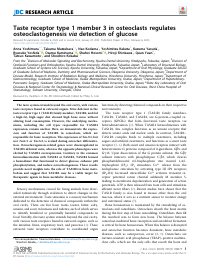
| 抄録 | The taste system extends beyond the oral cavity, with various taste receptors found in extraoral organs. Mice deficient in the taste receptor type 1 (TAS1R) family member, TAS1R3, and fed a high-fat, high-sugar diet showed high bone mass without altering food consumption. However, the underlying mechanisms, including the cell types responsible for TAS1R3 expression, remain unclear. Here, we demonstrate the expression and function of TAS1R3 in osteoclasts, which are responsible for bone resorption. The expression of Tas1r3, but not Tas1r1 or Tas1r2, is evoked during osteoclast differentiation. Osteoclastogenesis-related genes were downregulated in TAS1R3-deficient mice, whereas the opposite phenotypes were elicited by TAS1R3 overexpression. Contrary to the common heterodimerization with TAS1R1 or TAS1R2, TAS1R3 formed a homodimer that functioned to detect glucose, enhance p38 phosphorylation, and induce osteoclastogenesis. These results provide novel insights into the role of TAS1R3 in bone metabolism and suggest that TAS1R3 may be a viable target for therapeutic agents in bone metabolic diseases.
|
| キーワード | glucose
osteoclasts
p38
TAS1R3
taste receptor
|
| 発行日 | 2025-03
|
| 出版物タイトル |
Journal of Biological Chemistry
|
| 巻 | 301巻
|
| 号 | 3号
|
| 出版者 | Elsevier BV
|
| 開始ページ | 108273
|
| ISSN | 0021-9258
|
| NCID | AA00251083
|
| 資料タイプ |
学術雑誌論文
|
| 言語 |
英語
|
| OAI-PMH Set |
岡山大学
|
| 著作権者 | © 2025 The Authors.
|
| 論文のバージョン | publisher
|
| PubMed ID | |
| DOI | |
| Web of Science KeyUT | |
| 関連URL | isVersionOf https://doi.org/10.1016/j.jbc.2025.108273
|
| ライセンス | http://creativecommons.org/licenses/by/4.0/
|
| 助成情報 |
( 公益財団法人三島海雲記念財団 / Mishima Kaiun Memorial Foundation )
( うま味研究会 / Society for Research on Umami Taste )
21K09830:
細胞骨格関連分子Kidによる骨・軟骨代謝制御機構の解明
( 独立行政法人日本学術振興会 / Japan Society for the Promotion of Science )
22K20998:
破骨細胞における糖質検知とその分化制御メカニズムの解明
( 独立行政法人日本学術振興会 / Japan Society for the Promotion of Science )
23K16189:
骨芽細胞における糖質センシングと骨形成制御メカニズムの解明
( 独立行政法人日本学術振興会 / Japan Society for the Promotion of Science )
21H03144:
がん・骨格筋連関の解明により口腔扁平上皮がんの浸潤を制御する分子基盤の確立
( 独立行政法人日本学術振興会 / Japan Society for the Promotion of Science )
22KK0141:
新たな骨再生医療創成に向けた間葉系幹細胞の再定義とエネルギーセンシング機構の解明
( 独立行政法人日本学術振興会 / Japan Society for the Promotion of Science )
|