| ID | 70854 |
| JaLCDOI | |
| フルテキストURL | |
| 著者 |
Kubo, Takuya
Department of Emergency, Critical Care and Disaster Medicine, Faculty of Medicine, Dentistry and Pharmaceutical Sciences, Okayama University
Tsukahara, Kohei
Department of Emergency, Critical Care and Disaster Medicine, Faculty of Medicine, Dentistry and Pharmaceutical Sciences, Okayama University
publons
Hongo, Takashi
Department of Emergency, Critical Care and Disaster Medicine, Faculty of Medicine, Dentistry and Pharmaceutical Sciences, Okayama University
Obara, Takafumi
Department of Emergency, Critical Care and Disaster Medicine, Faculty of Medicine, Dentistry and Pharmaceutical Sciences, Okayama University
Kosaki, Yoshinori
Department of Emergency, Critical Care and Disaster Medicine, Faculty of Medicine, Dentistry and Pharmaceutical Sciences, Okayama University
Nojima, Tsuyoshi
Department of Emergency, Critical Care and Disaster Medicine, Faculty of Medicine, Dentistry and Pharmaceutical Sciences, Okayama University
ORCID
Kaken ID
publons
researchmap
Yumoto, Tetsuya
Department of Emergency, Critical Care and Disaster Medicine, Faculty of Medicine, Dentistry and Pharmaceutical Sciences, Okayama University
ORCID
Kaken ID
publons
Naito, Hiromichi
Department of Emergency, Critical Care and Disaster Medicine, Faculty of Medicine, Dentistry and Pharmaceutical Sciences, Okayama University
ORCID
Kaken ID
publons
Nakao, Atsunori
Department of Emergency, Critical Care and Disaster Medicine, Faculty of Medicine, Dentistry and Pharmaceutical Sciences, Okayama University
Kaken ID
|
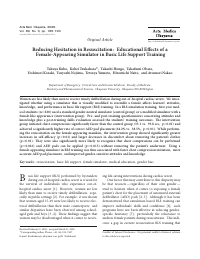
| 抄録 | Women are less likely than men to receive timely defibrillation during out-of-hospital cardiac arrest. We investigated whether using a simulator that is visually modified to resemble a female affects learners’ attitudes, knowledge, and performance in basic life support (BLS) training. In a BLS simulation training, first-year medical students (n=220) used a standard gender-neutral simulator (control group) or a modified simulator with a female-like appearance (intervention group). Pre- and post-training questionnaires concerning attitudes and knowledge plus a post-training skills evaluation assessed the students’ training outcomes. The intervention group initiated chest compressions significantly faster than the control group (33.1 vs. 39.8 sec, p<0.01) and achieved a significantly higher rate of correct AED pad placement (64.2% vs. 38.5%, p<0.01). While performing the resuscitation on the female-appearing manikin, the intervention group showed significantly greater increases in self-efficacy (p<0.01) and larger decreases in discomfort about removing the patient’s clothes (p<0.01). They were also significantly more likely to recognize that chest compressions can be performed (p=0.016) and AED pads can be applied (p=0.015) without removing the patient’s underwear. Using a female-appearing simulator in BLS training was thus associated with faster chest compression initiation, more accurate AED pad placement, and improved gender-sensitive attitudes and knowledge.
|
| キーワード | resuscitation
basic life support
female simulator
medical education
gender bias
|
| Amo Type | Original Article
|
| 出版物タイトル |
Acta Medica Okayama
|
| 発行日 | 2026-06
|
| 巻 | 80巻
|
| 号 | 3号
|
| 出版者 | Okayama University Medical School
|
| 開始ページ | 185
|
| 終了ページ | 193
|
| ISSN | 0386-300X
|
| NCID | AA00508441
|
| 資料タイプ |
学術雑誌論文
|
| 言語 |
英語
|
| 著作権者 | Copyright Ⓒ 2026 by Okayama University Medical School
|
| 論文のバージョン | publisher
|
| 査読 |
有り
|
| PubMed ID | |
| Web of Science KeyUT |