| ID | 71214 |
| フルテキストURL | |
| 著者 |
Umeda, Yuzo
Department of Gastroenterological Surgery, Okayama University Graduate School of Medicine, Dentistry and Pharmaceutical Sciences
Kaken ID
researchmap
Mitsuhashi, Toshiharu
Center for Innovative Clinical Medicine, Medical Development Field, Okayama University
Kaken ID
researchmap
Fuji, Tomokazu
Department of Gastroenterological Surgery, Okayama University Graduate School of Medicine, Dentistry and Pharmaceutical Sciences
Kojima, Toru
Department of Surgery, Okayama Saiseikai General Hospital
Koujima, Takeshi
Department of Surgery, Himeji Red Cross Hospital
Matsuda, Tatsuo
Department of Surgery, Tenwakai Matsuda Hospital
Satoh, Daisuke
Department of Surgery, Hiroshima Citizens Hospital
Inagaki, Masaru
Department of Surgery, National Hospital Organization Fukuyama Medical Center
Takagi, Kosei
Department of Gastroenterological Surgery, Okayama University Graduate School of Medicine, Dentistry and Pharmaceutical Sciences
Fujiwara, Toshiyoshi
Department of Gastroenterological Surgery, Okayama University Graduate School of Medicine, Dentistry and Pharmaceutical Sciences
ORCID
Kaken ID
publons
researchmap
|
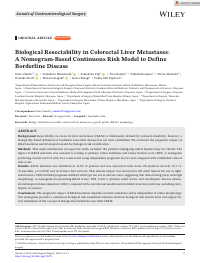
| 抄録 | Background: Resectability in colorectal liver metastases (CRLM) is traditionally defined by technical feasibility; however, a biologically based definition of borderline resectable disease has not been established. We evaluated the prognostic impact of KRAS mutation and developed a model for biological risk stratification.
Methods: This multi-institutional retrospective study included 584 patients undergoing initial hepatectomy for CRLM. The impact of KRAS mutation was assessed according to primary tumor sidedness and tumor burden score (TBS). A nomogram predicting overall survival (OS) was constructed using independent prognostic factors and compared with established clinical risk scores. Results: KRAS mutation was identified in 36.8% of patients and was associated with worse OS (median survival: 47.3 vs. 70.6 months, p = 0.0006) and recurrence-free survival. This adverse impact was observed in left-sided tumors but not in right-sided tumors. TBS stratified prognosis in KRAS wild-type but not in mutant cases, suggesting that tumor biology may outweigh morphology. A nomogram incorporating KRAS status, TBS, CA19-9, primary nodal status, and extrahepatic disease demonstrated improved discriminatory ability compared with conventional models and stratified recurrence patterns, including extrahepatic recurrence. Conclusions: The prognostic impact of KRAS mutation depends on tumor sidedness and is independent of tumor morphology. Our nomogram provides a continuous biological risk assessment and may facilitate biological risk stratification and support future refinement of the concept of biologically borderline resectable CRLM. |
| キーワード | biology
borderline resectable
colorectal liver metastases
genetic profile
KRAS
morphology
|
| 発行日 | 2026-09-08
|
| 出版物タイトル |
Annals of Gastroenterological Surgery
|
| 出版者 | Wiley
|
| ISSN | 2475-0328
|
| 資料タイプ |
学術雑誌論文
|
| 言語 |
英語
|
| OAI-PMH Set |
岡山大学
|
| 著作権者 | © 2026 The Author(s).
|
| 論文のバージョン | publisher
|
| PubMed ID | |
| DOI | |
| Web of Science KeyUT | |
| 関連URL | isVersionOf https://doi.org/10.1002/ags3.70278
|
| ライセンス | http://creativecommons.org/licenses/by/4.0/
|
| 助成情報 |
( Okayama Medical Foundation )
22K08775:
胆管癌のmolecular subtype分類の構築
( 独立行政法人日本学術振興会 / Japan Society for the Promotion of Science )
|