| ID | 70235 |
| フルテキストURL | |
| 著者 |
Takenoshita, Shintaro
Department of Neuropsychiatry, Okayama University Hospital
ORCID
Kaken ID
researchmap
Terada, Seishi
Department of Neuropsychiatry, Faculty of Medicine, Dentistry and Pharmaceutical Sciences, Okayama University
Kaken ID
publons
researchmap
Inoue, Tomokazu
Asahigawaso Research Institute, Social Welfare Corporation Asahigawaso
Kurozumi, Taku
Asahigawaso Research Institute, Social Welfare Corporation Asahigawaso
Takaki, Manabu
Department of Neuropsychiatry, Faculty of Medicine, Dentistry and Pharmaceutical Sciences, Okayama University
Kaken ID
publons
researchmap
Kuwano, Ryozo
Asahigawaso Research Institute, Social Welfare Corporation Asahigawaso
Suemitsu, Shigeru
Asahigawaso Research Institute, Social Welfare Corporation Asahigawaso
|
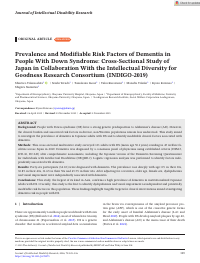
| 抄録 | Background: People with Down syndrome (DS) have a strong genetic predisposition to Alzheimer's disease (AD). However, the clinical burden and associated risk factors in diverse, non-Western populations remain less understood. This study aimed to investigate the prevalence of dementia in Japanese adults with DS and to identify modifiable clinical factors associated with dementia.
Methods: This cross-sectional multicentre study surveyed 133 adults with DS (mean age 50.1 years) residing in 45 welfare facilities across Japan in 2019. Dementia was diagnosed by a consensus panel of physicians using established criteria (DSM-5, ICD-10, DC-LD) after comprehensive assessments, including the Japanese version of the Dementia Screening Questionnaire for Individuals with Intellectual Disabilities (DSQIID-J). Logistic regression analysis was performed to identify factors independently associated with dementia. Results: Forty-six participants (34.6%) were diagnosed with dementia. The prevalence rose sharply with age: 0% in their 30s, 30.8% in their 40s, 31.6% in their 50s and 65.5% in their 60s. After adjusting for covariates, older age, female sex, dyslipidaemia and visual impairment were independently associated with dementia. Conclusions: This study, the largest of its kind in Asia, confirms a high prevalence of dementia in institutionalized Japanese adults with DS. Crucially, this study is the first to identify dyslipidaemia and visual impairment as independent and potentially modifiable risk factors in this population. These findings highlight tangible targets for clinical interventions aimed at mitigating dementia risk in people with DS. |
| 発行日 | 2025-12-24
|
| 出版物タイトル |
Journal of Intellectual Disability Research
|
| 巻 | 70巻
|
| 号 | 3号
|
| 出版者 | Wiley
|
| 開始ページ | 329
|
| 終了ページ | 336
|
| ISSN | 0964-2633
|
| NCID | AA10826829
|
| 資料タイプ |
学術雑誌論文
|
| 言語 |
英語
|
| OAI-PMH Set |
岡山大学
|
| 著作権者 | © 2025 The Author(s).
|
| 論文のバージョン | publisher
|
| PubMed ID | |
| DOI | |
| Web of Science KeyUT | |
| 関連URL | isVersionOf https://doi.org/10.1111/jir.70075
|
| ライセンス | http://creativecommons.org/licenses/by-nc-nd/4.0/
|
| Citation | Takenoshita, S., Terada, S., Inoue, T., Kurozumi, T., Takaki, M., Kuwano, R., and Suemitsu, S. (2026) Prevalence and Modifiable Risk Factors of Dementia in People With Down Syndrome: Cross-Sectional Study of Japan in Collaboration With the Intellectual Diversity for Goodness Research Consortium (INDIGO-2019). Journal of Intellectual Disability Research, 70: 329–336. https://doi.org/10.1111/jir.70075.
|
| 助成情報 |
2018488269:
( 公益財団法人日本財団 / Nippon Foundation )
21K15713:
てんかんと認知症疾患の統合的研究
( 独立行政法人日本学術振興会 / Japan Society for the Promotion of Science )
|