| ID | 69998 |
| フルテキストURL | |
| 著者 |
Gao, Tong
Department of Pathology and Experimental Medicine, Graduate School of Medicine, Dentistry and Pharmaceutical Sciences, Okayama University
Ito, Sachio
Department of Pathophysiology and Drug Discovery, Graduate School of Medicine, Dentistry and Pharmaceutical Sciences, Okayama University
Kaken ID
publons
researchmap
Moh-Moh-Aung, Aye
Department of Pathology and Experimental Medicine, Graduate School of Medicine, Dentistry and Pharmaceutical Sciences, Okayama University
Wang, Tianyi
Department of Pathology and Experimental Medicine, Graduate School of Medicine, Dentistry and Pharmaceutical Sciences, Okayama University
Fujisawa, Masayoshi
Department of Pathology and Experimental Medicine, Graduate School of Medicine, Dentistry and Pharmaceutical Sciences, Okayama University
ORCID
Ohara, Toshiaki
Department of Pathology and Experimental Medicine, Graduate School of Medicine, Dentistry and Pharmaceutical Sciences, Okayama University
ORCID
Kaken ID
publons
researchmap
Yoshimura, Teizo
Department of Pathology and Experimental Medicine, Graduate School of Medicine, Dentistry and Pharmaceutical Sciences, Okayama University
Kaken ID
Matsukawa, Akihiro
Department of Pathology and Experimental Medicine, Graduate School of Medicine, Dentistry and Pharmaceutical Sciences, Okayama University
ORCID
Kaken ID
publons
researchmap
|
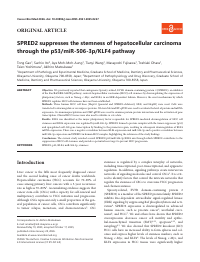
| 抄録 | Objective: We previously reported that endogenous Sprouty-related, EVH1 domain-containing protein 2 (SPRED2), an inhibitor of the Ras/Raf/ERK-MAPK pathway, controls hepatocellular carcinoma (HCC) cell stemness by downregulating the expression of pluripotency factors, such as Nanog, c-Myc, and KLF4, in an ERK-dependent fashion. However, the exact mechanisms by which SPRED2 regulates HCC cell stemness have not been established.
Methods: Three human HCC cell lines [HepG2 (parental and SPRED2-deficient), HLE, and Hep3B] were used. Cells were transfected to downregulate or overexpress proteins. Western blot and RT-qPCR were used to evaluate the level of protein and mRNA expression. Co-immunoprecipitation and ChIP-qPCR were used to examine protein-protein interactions and the activation of gene transcription. Clinical HCC tissues were also used to validate in vitro data. Results: KLF4 was identified as the major pluripotency factor responsible for SPRED2-mediated downregulation of HCC cell stemness and KLF4 expression was regulated by miR-506-3p. SPRED2 formed a protein complex with the tumor suppressor (p53) and upregulated miR-506 gene transcription by binding to the promoter region, resulting in subsequent downregulation of KLF4 mRNA expression. There was a negative correlation between KLF4 expression and miR-506-3p and a positive correlation between miR-506-3p expression and SPRED2 in human HCC samples, highlighting the relevance of the study findings. Conclusions: The current study revealed a novel SPRED2/p53/miR-506-3p/KLF4 axis through which SPRED2 contributes to the suppression of HCC cell stemness and provides a potential new target to prevent HCC progression. |
| キーワード | SPRED2
p53
KLF4
miR-506-3p
stemness
|
| 発行日 | 2026-01-20
|
| 出版物タイトル |
Cancer Biology & Medicine
|
| 出版者 | China Anti-cancer Association
|
| ISSN | 2095-3941
|
| 資料タイプ |
学術雑誌論文
|
| 言語 |
英語
|
| OAI-PMH Set |
岡山大学
|
| 著作権者 | ©2026 The Authors.
|
| 論文のバージョン | publisher
|
| PubMed ID | |
| DOI | |
| 関連URL | isVersionOf https://doi.org/10.20892/j.issn.2095-3941.2025.0247
|
| ライセンス | https://creativecommons.org/licenses/by-nc/4.0/
|
| Citation | Gao T, Ito S, Moh-Moh-Aung A, Wang T, Fujisawa M, Ohara T, et al. SPRED2 suppresses the stemness of hepatocellular carcinoma through the p53/miR-506-3p/KLF4 pathway. Cancer Biol Med. 2026; x: xx-xx. doi: 10.20892/j.issn.2095-3941.2025.0247
|
| 助成情報 |
25293095:
Ras-Raf-ERK/MAPK経路抑制による炎症・がん制御の分子機構
( 独立行政法人日本学術振興会 / Japan Society for the Promotion of Science )
90264283:
( 独立行政法人日本学術振興会 / Japan Society for the Promotion of Science )
22K19562:
メッセージカプセル・エクソソームによるがん転移のメカニズム解明と封じ込め戦略
( 独立行政法人日本学術振興会 / Japan Society for the Promotion of Science )
|