| ID | 71199 |
| フルテキストURL | |
| 著者 |
Okahara, Shuji
Department of Intensive Care, Okayama University Hospital
Fukushima, Shinnosuke
Department of Bacteriology, Okayama University Graduate School of Medicine, Dentistry and Pharmaceutical Sciences
Hamaguchi, Yuto
Department of Anesthesiology and Resuscitology, Okayama University Hospital
Hishiike, Masanobu
Department of Anesthesiology and Resuscitology, Okayama University Hospital
Motoi, Yohei
Department of Anesthesiology and Resuscitology, Okayama University Hospital
Gotoh, Kazuyoshi
Department of Medical Laboratory Science, Okayama University Graduate School of Health Sciences
Tsuji, Shuma
Department of Medical Laboratory Science, Okayama University Graduate School of Health Sciences
Iio, Koji
Microbiology Division, Clinical Laboratory, Okayama University Hospital
Hagiya, Hideharu
Department of Infectious Diseases, Okayama University Hospital
ORCID
Kaken ID
researchmap
|
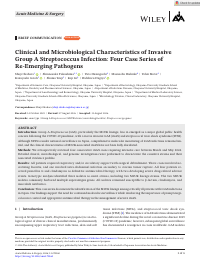
| 抄録 | Introduction: Group A Streptococcus (GAS), particularly the M1UK lineage, has re-emerged as a major global public health concern following the COVID-19 pandemic, with a rise in invasive GAS (iGAS) and streptococcal toxic shock syndrome (STSS). Although STSS is under national surveillance in Japan, comprehensive molecular monitoring of iGAS infections remains limited, and the clinical characteristics of M1UK-associated iGAS have not been fully elucidated.
Methods: We retrospectively reviewed four consecutive iGAS cases requiring intensive care between March and May 2024. Detailed clinical, microbiological, and genomic investigations were performed to characterize the causative strains and their associated virulence profiles. Results: All patients required respiratory and/or circulatory support with surgical debridement. Three cases involved necrotizing fasciitis, and one involved intra-abdominal infection secondary to ovarian tumor rupture. All four patients received penicillin G and clindamycin as definitive antimicrobial therapy, with two developing severe drug-related adverse events. Genotypic analysis identified three isolates as emm1 strains, including two M1UK lineage strains. The two M1UK isolates commonly harbored multiple superantigen genes. All isolates remained susceptible to β-lactam, clindamycin, and macrolide antibiotics. Conclusion: This case series documents the identification of the M1UK lineage among critically ill patients with iGAS infections in Japan. Our findings support the need for continued molecular surveillance while reinforcing the importance of prompt surgical source control and appropriate antimicrobial therapy in the management of severe iGAS. |
| キーワード | emm type
Group A Streptococcus
M1UK strain
necrotizing fasciitis
Streptococcus pyogenes
|
| 発行日 | 2026-01
|
| 出版物タイトル |
Acute Medicine & Surgery
|
| 巻 | 13巻
|
| 号 | 1号
|
| 出版者 | Wiley
|
| 開始ページ | e70160
|
| ISSN | 2052-8817
|
| 資料タイプ |
学術雑誌論文
|
| 言語 |
英語
|
| OAI-PMH Set |
岡山大学
|
| 著作権者 | © 2026 The Author(s).
|
| 論文のバージョン | publisher
|
| DOI | |
| Web of Science KeyUT | |
| 関連URL | isVersionOf https://doi.org/10.1002/ams2.70160
|
| ライセンス | http://creativecommons.org/licenses/by-nc/4.0/
|
| Citation | S. Okahara, S. Fukushima, Y. Hamaguchi, et al., “ Clinical and Microbiological Characteristics of Invasive Group A Streptococcus Infection: Four Case Series of Re-Emerging Pathogens,” Acute Medicine & Surgery 13, no. 1 (2026): e70160, https://doi.org/10.1002/ams2.70160.
|