| ID | 70788 |
| フルテキストURL | |
| 著者 |
Yumoto, Tetsuya
Department of Emergency, Critical Care, and Disaster Medicine, Faculty of Medicine, Dentistry, and Pharmaceutical Sciences, Okayama University
ORCID
Kaken ID
publons
Naito, Hiromichi
Department of Emergency, Critical Care, and Disaster Medicine, Faculty of Medicine, Dentistry, and Pharmaceutical Sciences, Okayama University
ORCID
Kaken ID
publons
Hayakawa, Mineji
Department of Emergency Medicine, Hokkaido University Hospital
Yokobori, Shoji
Department of Emergency and Critical Care Medicine, Nippon Medical School
Nishiyama, Kei
Division of Emergency and Critical Care Medicine, Niigata University Graduate School of Medical and Dental Science
Atsumi, Takahiro
Department of Emergency and Disaster Medicine, Hamamatsu University School of Medicine
Tasaki, Osamu
Acute and Critical Care Center, Nagasaki University Hospital
Tsurukiri, Junya
Emergency and Critical Care Medicine, Tokyo Medical University Hachioji Medical Center
Hayamizu, Mariko
Department of Emergency Medicine, Hokkaido University Hospital
Murahashi, Shimon
Acute and Critical Care Center, Nagasaki University Hospital
Hayashi, Munehiro
Department of Emergency and Critical Care Medicine, Japanese Red Cross Medical Center
Nishimura, Takeshi
Department of Emergency and Critical Care Medicine, Hyogo Emergency Medical Center
Goto, Yukari
Department of Emergency Medicine, Nagoya Ekisaikai Hospital
Narumiya, Hiromichi
Department of Emergency and Critical Care Medicine, Japanese Red Cross Kyoto Daini Hospital
Mizutani, Atsushi
Department of Emergency Medicine, Hamamatsu Medical Center
Miyajima, Mamoru
Emergency and Critical Care Center, Nagaoka Red Cross Hospital
Shimazaki, Junya
Department of Emergency and Critical Care Medicine, Kansai Medical University Medical Center
Miura, Takeshi
Department of Emergency and Critical Care Medicine, Institute of Medicine, University of Tsukuba Hospital
Shima, Nozomu
Department of Emergency and Critical Care Medicine, Wakayama Medical University
Deuchi, Kazuki
Division of Emergency and Critical Care Medicine, Niigata University Graduate School of Medical and Dental Science
Nakayasu, Hitomi
Emergency and Critical Care Medicine, Seirei Hamamatsu General Hospital
Kano, Hitoshi
Department of Emergency and Critical Care Medicine, Nippon Medical School
Yorifuji, Takashi
Department of Epidemiology, Faculty of Medicine, Dentistry and Pharmaceutical Sciences, Okayama University
ORCID
Kaken ID
publons
researchmap
Nakao, Atsunori
Department of Emergency, Critical Care, and Disaster Medicine, Faculty of Medicine, Dentistry, and Pharmaceutical Sciences, Okayama University
Kaken ID
Japan Comprehensive Process for End-of-Life Care and Organ Donation after Brain Death (J-RESPECT) study group
|
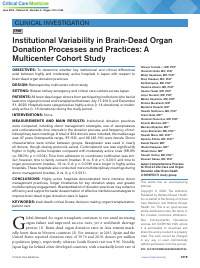
| 抄録 | OBJECTIVES: To determine whether key institutional and clinical differences exist between highly and moderately active hospitals in Japan with respect to brain-dead organ donation practices.
DESIGN: Retrospective multicenter cohort study. SETTING: Sixteen tertiary emergency and critical care centers across Japan. PATIENTS: All brain-dead organ donors from participating institutions who had at least one organ procured and transplanted between July 17, 2010, and December 31, 2023. Hospitals were categorized as highly active (≥ 14 donations) or moderately active (≤ 13 donations) during the study period. INTERVENTIONS: None. MEASUREMENTS AND MAIN RESULTS: Institutional donation practices were compared, including donor management strategies, use of vasopressors and corticosteroids, time intervals in the donation process, and frequency of multidisciplinary team meetings. A total of 204 donors were included; the median age was 47 years (interquartile range, 37–56), and 92 (45.1%) were female. Donor characteristics were similar between groups. Vasopressin was used in nearly all donors, though dosing protocols varied. Corticosteroid use was significantly higher in highly active hospitals compared with moderately active ones (58.3% vs. 38.0%; p = 0.004). Time from admission to coordinator notification was similar; however, time to family consent (median, 8 vs. 5 d; p < 0.001) and time to organ procurement (median, 12 vs. 9 d; p = 0.006) were longer in highly active hospitals. These hospitals also conducted more multidisciplinary meetings during donor management (median, 2 vs. 0; p < 0.001). CONCLUSIONS: Highly active hospitals demonstrated more intensive donor management practices, longer timeframes for key donation steps, and greater multidisciplinary engagement. Standardization of donation practices may enhance efficiency and support broader dissemination of effective institutional strategies to improve brain-dead organ donation rates in Japan. |
| キーワード | brain death
critical illness
decision-making
organ transplantation
patient care
|
| 発行日 | 2026-03-26
|
| 出版物タイトル |
Critical Care Medicine
|
| 巻 | 54巻
|
| 号 | 6号
|
| 出版者 | Ovid Technologies (Wolters Kluwer Health)
|
| 開始ページ | 1319
|
| 終了ページ | 1328
|
| ISSN | 0090-3493
|
| NCID | AA00620383
|
| 資料タイプ |
学術雑誌論文
|
| 言語 |
英語
|
| OAI-PMH Set |
岡山大学
|
| 著作権者 | © 2026 The Author(s).
|
| 論文のバージョン | publisher
|
| PubMed ID | |
| DOI | |
| Web of Science KeyUT | |
| 関連URL | isVersionOf https://doi.org/10.1097/ccm.0000000000007120
|
| ライセンス | http://creativecommons.org/licenses/by-nc-nd/4.0/
|
| 助成番号 | Yumoto, Tetsuya MD, PhD1; Naito, Hiromichi MD, PhD1; Hayakawa, Mineji MD, PhD2; Yokobori, Shoji MD, PhD3; Nishiyama, Kei MD, PhD4; Atsumi, Takahiro MD, PhD5; Tasaki, Osamu MD, PhD6; Tsurukiri, Junya MD, PhD7; Hayamizu, Mariko MD, PhD2; Murahashi, Shimon MD6; Hayashi, Munehiro MD8; Nishimura, Takeshi MD, PhD9; Goto, Yukari MD10; Narumiya, Hiromichi MD, PhD11; Mizutani, Atsushi MD12; Miyajima, Mamoru MD13; Shimazaki, Junya MD, PhD14; Miura, Takeshi MD, PhD15; Shima, Nozomu MD, PhD16; Deuchi, Kazuki MD4; Nakayasu, Hitomi MD17; Kano, Hitoshi MD3; Yorifuji, Takashi MD, PhD18; Nakao, Atsunori MD, PhD1; Japan Comprehensive Process for End-of-Life Care and Organ Donation after Brain Death (J-RESPECT) study group. Institutional Variability in Brain-Dead Organ Donation Processes and Practices: A Multicenter Cohort Study. Critical Care Medicine 54(6):p 1319-1328, June 2026. | DOI: 10.1097/CCM.0000000000007120
|