| ID | 70226 |
| フルテキストURL | |
| 著者 |
Mori, Sho
Division of Rheumatology and Allergology, Department of Internal Medicine, St. Marianna University School of Medicine
Shabana, Kosuke
Department of Pediatrics, Osaka Medical and Pharmaceutical University
Matsui, Toshihiro
Department of Rheumatology Research, Clinical Research Center for Allergy and Rheumatology, National Hospital Organization Sagamihara National Hospital
Nozawa, Tomo
Department of Pediatrics, Graduate School of Medicine, Yokohama City University
Sugita, Yuko
Department of Pediatrics, Osaka Medical and Pharmaceutical University
Tomiita, Minako
Department of Allergy and Rheumatology, Chiba Children’s Hospital
Nakagishi, Yasuo
Department of Pediatric Rheumatology, Hyogo Prefectural Kobe Children’s Hospital
Yamasaki, Yuichi
Department of Pediatrics, Kagoshima University Hospital
Umebayashi, Hiroaki
Department of General Pediatrics, Miyagi Children’s Hospital
Yashiro, Masato
Department of Pediatrics, Okayama University Hospital
Kaken ID
Iwata, Naomi
Department of Infection and Immunology, Allergy and Immunology Center, Aichi Children’s Health and Medical Center
Yasumura, Junko
Department of Pediatrics, Hiroshima University Graduate School of Biomedical and Health Sciences
Wakiguchi, Hiroyuki
Department of Pediatrics, Yamaguchi University Graduate School of Medicine
Yamamoto, Takeshi
Department of Pediatrics, Chiba University Graduate School of Medicine
Takezaki, Shunichiro
Department of Pediatrics, Faculty of Medicinea and Graduate School of Medicine, Hokkaido University
Okura, Yuka
Center for Pediatric Allergy and Rheumatology, KKR Sapporo Medical Center
Yokoyama, Tadafumi
Department of Pediatrics, Kanazawa University
Shimizu, Masaki
Department of Pediatrics, Perinatal and Maternal Medicine, Graduate School of Medical and Dental Sciences, Institute of Science Tokyo
Hirayama, Masahiro
Department of Pediatrics, Mie University Graduate School of Medicine
Tohma, Shigeto
Department of Rheumatology, National Hospital Organization Tokyo National Hospital
Okamoto, Nami
Department of Pediatrics, Osaka Medical and Pharmaceutical University
Mori, Masaaki
Division of Rheumatology and Allergology, Department of Internal Medicine, St. Marianna University School of Medicine
|
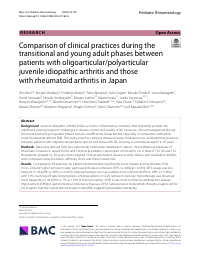
| 抄録 | Background Juvenile idiopathic arthritis (JIA) is a chronic inflammatory condition that frequently persists into adulthood, posing long-term challenges in disease control and quality of life. However, clinical management during the transitional and young adult phases remains insufficiently characterized, especially in comparison with adult-onset rheumatoid arthritis (RA). This study aimed to compare disease activity, medication use, and treatment practices between patients with oligoarticular/polyarticular JIA and those with RA, focusing on individuals aged 16–30 years.
Methods Data were derived from two nationwide multicenter databases in Japan—NinJa (National Database of Rheumatic Diseases in Japan) for RA and CoNinJa (a pediatric counterpart of NinJa) for JIA. A total of 176 JIA and 152 RA patients, all aged 16–30 years, were analyzed. Clinical parameters, disease activity indices, and medication profiles were compared using the Mann–Whitney U test and Fisher’s exact test. Results Compared to RA patients, JIA patients demonstrated significantly lower disease activity (median SDAI 0.6 vs. 2.4) and higher remission rates, particularly Boolean remission (70% vs. 44%) (p < 0.001). MTX usage was less frequent in JIA (49% vs. 68%, p < 0.001), whereas biologic use was notably more common (69% vs. 38%, p < 0.001), with 31% involving off-label prescriptions. Among patients in CDAI remission, biologic monotherapy was observed more frequently in JIA (29% vs. 7%, p < 0.001). Discontinuation of MTX was most commonly attributed to disease improvement (58%) or gastrointestinal intolerance (nausea, 29%). Subcutaneous tocilizumab, though unapproved for JIA in Japan, had the lowest discontinuation rate (4%), suggesting favorable tolerability. Conclusions Despite an overlap in age, patients with JIA and RA exhibit distinct disease characteristics and therapeutic patterns. These differences underscore the need to expand approved treatment options for JIA, promote equitable access to biologics, and strengthen transitional care frameworks. Further research is warranted to explore long-term outcomes, reproductive health considerations, and socioeconomic barriers that influence treatment continuity in young adults with childhood-onset arthritis. |
| キーワード | Juvenile idiopathic arthritis
Rheumatoid arthritis
Disease activity
Biologics
Methotrexate
|
| 発行日 | 2025-11-24
|
| 出版物タイトル |
Pediatric Rheumatology
|
| 巻 | 23巻
|
| 号 | 1号
|
| 出版者 | Springer Science and Business Media LLC
|
| 開始ページ | 120
|
| ISSN | 1546-0096
|
| 資料タイプ |
学術雑誌論文
|
| 言語 |
英語
|
| OAI-PMH Set |
岡山大学
|
| 著作権者 | © The Author(s) 2025.
|
| 論文のバージョン | publisher
|
| PubMed ID | |
| DOI | |
| Web of Science KeyUT | |
| 関連URL | isVersionOf https://doi.org/10.1186/s12969-025-01164-6
|
| ライセンス | http://creativecommons.org/licenses/by-nc-nd/4.0/
|
| Citation | Mori, S., Shabana, K., Matsui, T. et al. Comparison of clinical practices during the transitional and young adult phases between patients with oligoarticular/polyarticular juvenile idiopathic arthritis and those with rheumatoid arthritis in Japan. Pediatr Rheumatol 23, 120 (2025). https://doi.org/10.1186/s12969-025-01164-6
|
| 助成情報 |
19FE1003:
( 厚生労働省 / Ministry of Health )
25ek0410112h0003:
関節リウマチ(RA)大規模データベースを用いた、移行期・AYA世代および妊娠期RA患者における疾患特性の異同を内包するライフステージの課題抽出とその解決に資する研究
( 国立研究開発法人日本医療研究開発機構 / Japan Agency for Medical Research and Development )
|