| ID | 69785 |
| フルテキストURL | |
| 著者 |
Tani, Yoshinori
Department of Obstetrics and Gynecology, Dentistry and Pharmaceutical Sciences, Okayama University Graduate School of Medicine
Nakamura, Keiichiro
Department of Obstetrics and Gynecology, Dentistry and Pharmaceutical Sciences, Okayama University Graduate School of Medicine
Kaken ID
publons
researchmap
Sugihara, Hanako
Department of Obstetrics and Gynecology, Dentistry and Pharmaceutical Sciences, Okayama University Graduate School of Medicine
Shirakawa, Shinsuke
Department of Obstetrics and Gynecology, Dentistry and Pharmaceutical Sciences, Okayama University Graduate School of Medicine
Matsuoka, Hirofumi
Department of Obstetrics and Gynecology, Dentistry and Pharmaceutical Sciences, Okayama University Graduate School of Medicine
Ida, Naoyuki
Department of Obstetrics and Gynecology, Dentistry and Pharmaceutical Sciences, Okayama University Graduate School of Medicine
Haraga, Junko
Department of Obstetrics and Gynecology, Dentistry and Pharmaceutical Sciences, Okayama University Graduate School of Medicine
Ogawa, Chikako
Department of Obstetrics and Gynecology, Dentistry and Pharmaceutical Sciences, Okayama University Graduate School of Medicine
Kaken ID
Eto, Eriko
Department of Obstetrics and Gynecology, Dentistry and Pharmaceutical Sciences, Okayama University Graduate School of Medicine
ORCID
Kaken ID
researchmap
Nagao, Shoji
Department of Obstetrics and Gynecology, Dentistry and Pharmaceutical Sciences, Okayama University Graduate School of Medicine
Masuyama, Hisashi
Department of Obstetrics and Gynecology, Dentistry and Pharmaceutical Sciences, Okayama University Graduate School of Medicine
Kaken ID
publons
researchmap
|
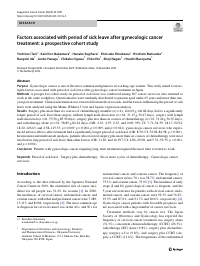
| 抄録 | Purpose Gynecologic cancer is one of the most common malignancies in working-age women. This study aimed to investigate factors associated with period of sick leave after gynecologic cancer treatment in Japan.
Methods A prospective cohort study on period of sick leave was conducted among 207 cancer survivors who returned to work at the same workplace. Questionnaires were randomly distributed to patients aged under 65 years and more than one-year post-treatment. Clinical information was extracted from medical records, and the factors influencing the period of sick leave were analyzed using the Mann–Whitney U test and logistic regression analysis. Results Surgery plus more than six courses of chemotherapy (number (n) = 41, 166.02 ± 146.84 days) led to a significantly longer period of sick leave than surgery without lymph node dissection (n = 64, 31.15 ± 30.47 days), surgery with lymph node dissection (n = 41, 55.56 ± 85.90 days), surgery plus less than six courses of chemotherapy (n = 21, 72.42 ± 56.07 days), and radiotherapy alone (n = 21, 58.85 ± 84.24 days) (OR: 2.63, 2.95, 2.67, and 2.08; 95% CI: 7.71–54.59, 18.17–92.94, 18.22–126.63, and 2.38–115.33; p = 0.009, p = 0.004, p = 0.009, and p = 0.041). gynecologic cancer survivors who experienced adverse effects after treatment had a significantly longer period of sick leave (OR: 8.50; CI: 52.98–84.98; p < 0.001). In univariate and multivariate analyses, patients who received surgery plus more than six courses of chemotherapy were most involved in long period of sick leave than other factors (OR: 11.20, and 16.997; CI: 4.86–25.08, and 5.51–52.35; p < 0.001, and p < 0.001). Conclusion Patients with gynecologic cancer requiring long-term treatment required the most time to return to work. |
| キーワード | Period of sick leave
Surgery plus chemotherapy
Six or more cycles of chemotherapy
Gynecologic cancer survivors
|
| 発行日 | 2025-11-19
|
| 出版物タイトル |
Supportive Care in Cancer
|
| 巻 | 33巻
|
| 号 | 12号
|
| 出版者 | Springer Science and Business Media LLC
|
| 開始ページ | 1087
|
| ISSN | 0941-4355
|
| NCID | AA10996793
|
| 資料タイプ |
学術雑誌論文
|
| 言語 |
英語
|
| OAI-PMH Set |
岡山大学
|
| 著作権者 | © The Author(s) 2025
|
| 論文のバージョン | publisher
|
| PubMed ID | |
| DOI | |
| Web of Science KeyUT | |
| 関連URL | isVersionOf https://doi.org/10.1007/s00520-025-10116-5
|
| ライセンス | http://creativecommons.org/licenses/by/4.0/
|
| Citation | Tani, Y., Nakamura, K., Sugihara, H. et al. Factors associated with period of sick leave after gynecologic cancer treatment: a prospective cohort study. Support Care Cancer 33, 1087 (2025). https://doi.org/10.1007/s00520-025-10116-5
|
| 助成情報 |
( 国立大学法人岡山大学 / Okayama University )
|