| ID | 70145 |
| フルテキストURL | |
| 著者 |
Takagi, Kosei
Department of Gastroenterological Surgery, Okayama University Graduate School of Medicine, Dentistry, and Pharmaceutical Sciences
ORCID
publons
Yamada, Motohiko
Department of Gastroenterological Surgery, Okayama University Graduate School of Medicine, Dentistry, and Pharmaceutical Sciences
Fuji, Tomokazu
Department of Gastroenterological Surgery, Okayama University Graduate School of Medicine, Dentistry, and Pharmaceutical Sciences
Yasui, Kazuya
Department of Gastroenterological Surgery, Okayama University Graduate School of Medicine, Dentistry, and Pharmaceutical Sciences
Nishiyama, Takeyoshi
Department of Gastroenterological Surgery, Okayama University Graduate School of Medicine, Dentistry, and Pharmaceutical Sciences
Nagai, Yasuo
Department of Gastroenterological Surgery, Okayama University Graduate School of Medicine, Dentistry, and Pharmaceutical Sciences
Kanehira, Noriyuki
Department of Gastroenterological Surgery, Okayama University Graduate School of Medicine, Dentistry, and Pharmaceutical Sciences
Fujiwara, Toshiyoshi
Department of Gastroenterological Surgery, Okayama University Graduate School of Medicine, Dentistry, and Pharmaceutical Sciences
ORCID
Kaken ID
publons
researchmap
|
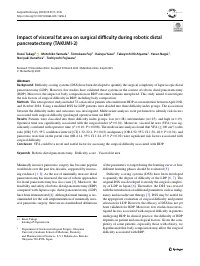
| 抄録 | Background: Difficulty scoring systems (DSS) have been developed to quantify the surgical complexity of laparoscopic distal pancreatectomy (LDP). However, few studies have validated these systems in the context of robotic distal pancreatectomy (RDP). Moreover, the impact of body composition on RDP outcomes remains unexplored. This study aimed to investigate the risk factors of surgical difficulty in RDP, including body composition.
Methods: This retrospective study included 72 consecutive patients who underwent RDP at our institution between April 2021 and October 2024. Using a modified DSS for LDP, patients were divided into three difficulty index groups. The association between the difficulty index and outcomes was investigated. Multivariate analyses were performed to identify risk factors associated with surgical difficulty (prolonged operative time) in RDP. Results: Patients were classified into three difficulty index groups: low (n = 28), intermediate (n = 25), and high (n = 19). Operative time was significantly associated with the surgical index (P = 0.01). Moreover, visceral fat area (VFA) was significantly correlated with operative time (r2 = 0.10, P = 0.008). The multivariate analyses found that VFA (≥ 100 cm2) (odds ratio [OR] 5.03, 95% confidence interval [CI] 1.32–22.4, P = 0.02), malignancy (OR 4.92, 95% CI 1.50–18.9, P = 0.01), and pancreatic resection on the portal vein (OR 4.14, 95% CI 1.24–15.9, P = 0.02) were significant risk factors associated with surgical difficulty. Conclusion: VFA could be a novel and useful factor for assessing the surgical difficulty associated with RDP. |
| キーワード | Robotic distal pancreatectomy
Difficulty score
Visceral fat area
|
| 発行日 | 2025-04-04
|
| 出版物タイトル |
Surgical Endoscopy
|
| 巻 | 39巻
|
| 号 | 5号
|
| 出版者 | Springer Science and Business Media LLC
|
| 開始ページ | 3137
|
| 終了ページ | 3145
|
| ISSN | 0930-2794
|
| NCID | AA10750363
|
| 資料タイプ |
学術雑誌論文
|
| 言語 |
英語
|
| OAI-PMH Set |
岡山大学
|
| 著作権者 | © The Author(s) 2025
|
| 論文のバージョン | publisher
|
| PubMed ID | |
| DOI | |
| Web of Science KeyUT | |
| 関連URL | isVersionOf https://doi.org/10.1007/s00464-025-11696-3
|
| ライセンス | http://creativecommons.org/licenses/by/4.0/
|
| Citation | Takagi, K., Yamada, M., Fuji, T. et al. Impact of visceral fat area on surgical difficulty during robotic distal pancreatectomy (TAKUMI-2). Surg Endosc 39, 3137–3145 (2025). https://doi.org/10.1007/s00464-025-11696-3
|
| 助成情報 |
( 国立大学法人岡山大学 / Okayama University )
|