| ID | 69900 |
| フルテキストURL | |
| 著者 |
Zhao, Maoxiang
Graduate School of Environmental and Life Science, Okayama University
Galib, Md. Asadulla Al
Graduate School of Environmental and Life Science, Okayama University
Nakamura, Toshiyuki
Graduate School of Environmental and Life Science, Okayama University
Nakamura, Yoshimasa
Graduate School of Environmental and Life Science, Okayama University
ORCID
Kaken ID
publons
researchmap
Hirai, Yoshihiko
Graduate School of Environmental and Life Science, Okayama University
Kaken ID
publons
researchmap
Munemasa, Shintaro
Graduate School of Environmental and Life Science, Okayama University
ORCID
Mori, Izumi C.
Institute of Plant Science and Resources, Okayama University
ORCID
Kaken ID
publons
researchmap
Murata, Yoshiyuki
Graduate School of Environmental and Life Science, Okayama University
ORCID
Kaken ID
publons
researchmap
|
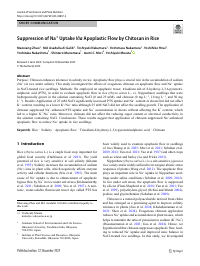
| 抄録 | Purpose: Chitosan enhances tolerance to salinity in rice. Apoplastic flow plays a crucial role in the accumulation of sodium (Na+) in rice under salinity. This study investigated the effects of exogenous chitosan on apoplastic flow and Na+ uptake in NaCl-treated rice seedlings. Methods: We employed an apoplastic tracer, trisodium salt of 8-hydroxy-1,3,6-pyrenetrisulphonic acid (PTS), in order to evaluate apoplastic flow in rice (Oryza sativa L., cv. Nipponbare) seedlings that were hydroponically grown in the solution containing NaCl (0 and 25 mM), and chitosan (0 mg L− 1, 10 mg L− 1, and 50 mg L− 1). Results: Application of 25 mM NaCl significantly increased PTS uptake and Na+ content in shoots but did not affect K+ content, resulting in a lower K+/Na+ ratio although 25 mM NaCl did not affect the seedling growth. The application of chitosan suppressed Na+-enhanced PTS uptake and Na+ accumulation in shoots without affecting the K+ content, which led to a higher K+/Na+ ratio. Moreover, chitosan did not affect the reducing sugar content or electrical conductivity in the solution containing NaCl. Conclusions: These results suggest that application of chitosan suppressed Na+-enhanced apoplastic flow to reduce Na+ uptake in rice seedlings.
|
| キーワード | Rice · Salinity
Apoplastic flow
Trisodium-8-hydroxy-1,3,6-pyrenetrisulphonic acid
Chitosan
|
| 発行日 | 2025-12-22
|
| 出版物タイトル |
Journal of Soil Science and Plant Nutrition
|
| 出版者 | Springer Science and Business Media LLC
|
| ISSN | 0718-9508
|
| 資料タイプ |
学術雑誌論文
|
| 言語 |
英語
|
| OAI-PMH Set |
岡山大学
|
| 著作権者 | © The Author(s) 2025
|
| 論文のバージョン | publisher
|
| DOI | |
| Web of Science KeyUT | |
| 関連URL | isVersionOf https://doi.org/10.1007/s42729-025-02857-3
|
| ライセンス | http://creativecommons.org/licenses/by/4.0/
|
| Citation | Zhao, M., Galib, M.A.A., Nakamura, T. et al. Suppression of Na+ Uptake Via Apoplastic Flow by Chitosan in Rice. J Soil Sci Plant Nutr (2025). https://doi.org/10.1007/s42729-025-02857-3
|
| 助成情報 |
JPMJSP2126:
( 国立研究開発法人科学技術振興機構 / Japan Science and Technology Agency )
|