| ID | 70243 |
| フルテキストURL | |
| 著者 |
Fuji, Tomokazu
Department of Gastroenterological Surgery, Dentistry, and Pharmaceutical Sciences, Okayama University Graduate School of Medicine
Takagi, Kosei
Department of Gastroenterological Surgery, Dentistry, and Pharmaceutical Sciences, Okayama University Graduate School of Medicine
ORCID
publons
Yasui, Kazuya
Department of Gastroenterological Surgery, Dentistry, and Pharmaceutical Sciences, Okayama University Graduate School of Medicine
Ito, Atene
Department of Gastroenterological Surgery, Dentistry, and Pharmaceutical Sciences, Okayama University Graduate School of Medicine
Nishiyama, Takeyoshi
Department of Gastroenterological Surgery, Dentistry, and Pharmaceutical Sciences, Okayama University Graduate School of Medicine
Nagai, Yasuo
Department of Gastroenterological Surgery, Dentistry, and Pharmaceutical Sciences, Okayama University Graduate School of Medicine
Yokoyama, Shohei
Department of Gastroenterological Surgery, Dentistry, and Pharmaceutical Sciences, Okayama University Graduate School of Medicine
Fujiwara, Toshiyoshi
Department of Gastroenterological Surgery, Dentistry, and Pharmaceutical Sciences, Okayama University Graduate School of Medicine
ORCID
Kaken ID
publons
researchmap
|
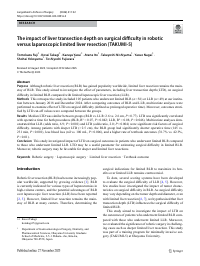
| 抄録 | Purpose Although robotic liver resection (RLR) has gained popularity worldwide, limited liver resection remains the mainstay of RLR. This study aimed to investigate the effect of parameters, including liver transection depth (LTD), on surgical difficulty in limited RLR compared with limited laparoscopic liver resection (LLR).
Methods This retrospective study included 105 patients who underwent limited RLR (n = 56) or LLR (n = 49) at our institution between January 2018 and December 2024. After comparing outcomes of RLR and LLR, multivariate analyses were performed to examine effect of LTD on surgical difficulty (defined as prolonged operative time). Moreover, outcomes stratified by LTD cut-off values were compared between the groups. Results Median LTD was similar between groups (RLR vs. LLR: 2.6 vs. 2.6 cm, P = 0.77). LTD was significantly correlated with operative time for both procedures (RLR, R² = 0.07, P = 0.042; LLR, R² = 0.08, P = 0.046). Multivariate analyses demonstrated that LLR (odds ratio, 6.9; P < 0.001) and LTD (odds ratio, 2.0; P = 0.004) were significant risk factors of surgical difficulty. Among patients with deeper LTD (> 2.5 cm), the RLR group had significantly shorter operative time (145 vs. 231 min, P < 0.001), less blood loss (nil vs. 100 mL, P = 0.006), and a higher rate of textbook outcomes (76.7% vs. 42.3%, P = 0.01). Conclusion This study investigated impact of LTD on surgical outcomes in patients who underwent limited RLR compared to those who underwent limited LLR. LTD may be a useful parameter for estimating surgical difficulty in limited RLR. Moreover, robotic surgery may be favorable for deeper and limited liver resections. |
| キーワード | Robotic surgery
Laparoscopic surgery
Limited liver resection
Textbook outcome
|
| 発行日 | 2025-11-27
|
| 出版物タイトル |
Langenbeck's Archives of Surgery
|
| 巻 | 411巻
|
| 号 | 1号
|
| 出版者 | Springer Science and Business Media LLC
|
| 開始ページ | 22
|
| ISSN | 1435-2451
|
| 資料タイプ |
学術雑誌論文
|
| 言語 |
英語
|
| OAI-PMH Set |
岡山大学
|
| 著作権者 | © The Author(s) 2025
|
| 論文のバージョン | publisher
|
| PubMed ID | |
| DOI | |
| Web of Science KeyUT | |
| 関連URL | isVersionOf https://doi.org/10.1007/s00423-025-03916-0
|
| ライセンス | http://creativecommons.org/licenses/by/4.0/
|
| Citation | Fuji, T., Takagi, K., Yasui, K. et al. The impact of liver transection depth on surgical difficulty in robotic versus laparoscopic limited liver resection (TAKUMI-5). Langenbecks Arch Surg 411, 22 (2026). https://doi.org/10.1007/s00423-025-03916-0
|
| 助成情報 |
( 国立大学法人岡山大学 / Okayama University )
|