| ID | 70987 |
| フルテキストURL | |
| 著者 |
Soga, Yoshihiko
Division of Hospital Dentistry, Okayama University Hospital
ORCID
Kaken ID
publons
researchmap
Matsuzaki, Kumiko
Division of Hospital Dentistry, Okayama University Hospital
Kosaki, Hirotaka
Division of Hospital Dentistry, Okayama University Hospital
Kishimoto, Tomoko
Division of Hospital Dentistry, Okayama University Hospital
Yoshitomi, Aiko
Division of Hospital Dentistry, Okayama University Hospital
Kajizono, Makoto
Department of Pharmacy, Okayama University Hospital
Makita, Takashi
Department of Pharmacy, Okayama University Hospital
Tanaka, Yuta
Department of Pharmacy, Okayama University Hospital
Zamami, Yoshito
Department of Pharmacy, Okayama University Hospital
ORCID
Kaken ID
publons
researchmap
Shien, Tadahiko
Department of Breast and Endocrine Surgery, Okayama University Hospital
ORCID
Kaken ID
publons
researchmap
Doihara, Hiroyoshi
Department of Surgery, Kawasaki Medical School General Medical Center
|
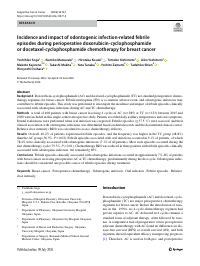
| 抄録 | Background Doxorubicin-cyclophosphamide (AC) and docetaxel-cyclophosphamide (TC) are standard perioperative chemotherapy regimens for breast cancer. Febrile neutropenia (FN) is a common adverse event, and odontogenic infections may contribute to febrile episodes. This study was performed to investigate the incidence and impact of febrile episodes clinically associated with odontogenic infections during AC and TC chemotherapy.
Methods A total of 408 patients with breast cancer receiving 4 cycles of AC (n = 285) or TC (n = 123) between 2015 and 2020 were included in this single-center retrospective study. Patients recorded daily axillary temperatures and oral symptoms. Dental evaluations were performed when oral infection was suspected. Febrile episodes (≥ 37.5 °C) were assessed, and their clinical association with odontogenic infections was determined based on dental records and the documented clinical course. Relative dose intensity (RDI) was calculated to assess chemotherapy delivery. Results Overall, 40.2% of patients experienced febrile episodes, and the frequency was higher in the TC group (48.8%) than the AC group (36.5%, P = 0.02). Febrile episodes associated with oral infections occurred in 9.1% of patients, of which 78.4% were clinically associated with odontogenic infections (7.1% of all patients). Most such episodes occurred during the first chemotherapy cycle (79.3%, P < 0.01). Chemotherapy RDI was reduced in three patients with febrile episodes clinically associated with odontogenic infection, but remained ≥ 85%. Conclusions Febrile episodes clinically associated with odontogenic infections occurred in approximately 7%–8% of patients with breast cancer receiving perioperative AC or TC chemotherapy, predominantly during the first cycle. Odontogenic infections should be considered one possible source of febrile episodes during treatment. |
| キーワード | Breast cancer
Perioperative chemotherapy
Odontogenic infection
Oral infection
Febrile episodes
Relative dose intensity
|
| 発行日 | 2026-07-09
|
| 出版物タイトル |
Supportive Care in Cancer
|
| 巻 | 34巻
|
| 号 | 8号
|
| 出版者 | Springer Science and Business Media LLC
|
| 開始ページ | 747
|
| ISSN | 0941-4355
|
| NCID | AA10996793
|
| 資料タイプ |
学術雑誌論文
|
| 言語 |
英語
|
| OAI-PMH Set |
岡山大学
|
| 著作権者 | © The Author(s) 2026
|
| 論文のバージョン | publisher
|
| PubMed ID | |
| DOI | |
| 関連URL | isVersionOf https://doi.org/10.1007/s00520-026-10977-4
|
| ライセンス | http://creativecommons.org/licenses/by/4.0/
|
| Citation | Soga, Y., Matsuzaki, K., Kosaki, H. et al. Incidence and impact of odontogenic infection-related febrile episodes during perioperative doxorubicin-cyclophosphamide or docetaxel-cyclophosphamide chemotherapy for breast cancer. Support Care Cancer 34, 747 (2026). https://doi.org/10.1007/s00520-026-10977-4
|
| 助成情報 |
( 国立大学法人岡山大学 / Okayama University )
22K09982:
歯性感染由来の発熱性好中球減少症リスク判断指標の解明-乳がん補助化学療法を対象に
( 独立行政法人日本学術振興会 / Japan Society for the Promotion of Science )
|