| ID | 71043 |
| フルテキストURL | |
| 著者 |
Yamada, Rio
Department of Molecular Hematopathology, Okayama University Graduate School of Health Sciences
Nishimura, Midori Filiz
Department of Molecular Hematopathology, Okayama University Graduate School of Health Sciences
Nishikori, Asami
Department of Molecular Hematopathology, Okayama University Graduate School of Health Sciences
Fukumi, Takuya
Department of Hematology, Okayama City Hospital
Ohsawa, Kumiko
Department of Pathology, Saitama Medical Center, Saitama Medical University
Momose, Shuji
Department of Pathology, Saitama Medical Center, Saitama Medical University
Sato, Yasuharu
Department of Molecular Hematopathology, Okayama University Graduate School of Health Sciences
ORCID
Kaken ID
researchmap
|
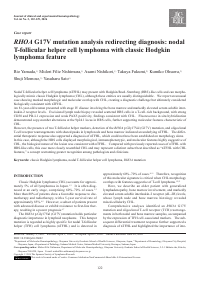
| 抄録 | Nodal T-follicular helper cell lymphoma (nTFHL) may present with Hodgkin/Reed–Sternberg (HRS)-like cells and can morphologically mimic classic Hodgkin lymphoma (CHL), although these entities are usually distinguishable. We report an unusual case showing marked morphologic and molecular overlap with CHL, creating a diagnostic challenge but ultimately considered biologically consistent with nTFHL.
An 81-year-old woman presented with stage IV disease involving the bone marrow and markedly elevated serum soluble interleukin-2 receptor levels. Excisional lymph node biopsy revealed scattered HRS cells in a T-cell–rich background, with strong CD30 and PD-L1 expression and weak PAX5 positivity, findings consistent with CHL. Fluorescence in situ hybridization demonstrated copy-number alterations at the 9p24.1 locus in HRS cells, further supporting molecular features characteristic of CHL. However, the presence of two T-follicular helper markers, detection of the RHOA p.Gly17Val (G17V) mutation, and oligoclonal T-cell receptor rearrangements with shared peaks in lymph node and bone marrow indicated an underlying nTFHL. The differential therapeutic response also supported a diagnosis of nTFHL, which could not have been established on morphology alone. In this case, although the HRS cells displayed morphological, immunophenotypic, and molecular features highly suggestive of CHL, the biological nature of the lesion was consistent with nTFHL. Compared with previously reported cases of nTFHL with HRS-like cells, this case more closely resembled CHL and may represent a distinct subset best described as “nTFHL with CHL features,” a concept warranting greater recognition among pathologists and clinicians. |
| キーワード | classic Hodgkin lymphoma
nodal T-follicular helper cell lymphoma
RHOA mutation
|
| 発行日 | 2026
|
| 出版物タイトル |
Journal of Clinical and Experimental Hematopathology
|
| 巻 | 66巻
|
| 号 | 2号
|
| 出版者 | Japanese Society for Lymphoreticular Tissue Research
|
| 開始ページ | 122
|
| 終了ページ | 129
|
| ISSN | 1346-4280
|
| NCID | AA11556796
|
| 資料タイプ |
学術雑誌論文
|
| 言語 |
英語
|
| OAI-PMH Set |
岡山大学
|
| 著作権者 | © 2026 The Japanese Society of Lymphoma Research
|
| 論文のバージョン | publisher
|
| PubMed ID | |
| DOI | |
| Web of Science KeyUT | |
| 関連URL | isVersionOf https://doi.org/10.3960/jslrt.26002
|
| ライセンス | https://creativecommons.org/licenses/by-nc-sa/4.0/
|
| 助成情報 |
( 文部科学省 / Ministry of Education )
( 公益財団法人両備檉園記念財団 / Ryobi Teien Memory Foundation )
|