| ID | 69976 |
| フルテキストURL | |
| 著者 |
Sugimoto, Koki
Faculty of Food and Nutritional Sciences, Toyo University
Nishiguchi, Hideto
Faculty of Chemistry, Materials, and Bioengineering, Kansai University
Hosomi, Ryota
Faculty of Chemistry, Materials, and Bioengineering, Kansai University
Tanizaki, Toshifumi
Bizen Chemical Co., Ltd.
Tsushima, Tadahiro
Bizen Chemical Co., Ltd.
Baba, Naomichi
Bizen Chemical Co., Ltd.
Misawa, Yoshihisa
Bizen Chemical Co., Ltd.
Wang, Ziyi
Department of Molecular Biology and Biochemistry, Okayama University Graduate School of Medicine, Dentistry and Pharmaceutical Sciences
Ono, Mitsuaki
Department of Oral Rehabilitation and Regenerative Medicine, Okayama University Graduate School of Medicine, Dentistry and Pharmaceutical Sciences
Kaken ID
researchmap
Murakami, Yuki
Department of Hygiene and Public Health, Kansai Medical University
Kanda, Seiji
Department of Hygiene and Public Health, Kansai Medical University
Fukunaga, Kenji
Faculty of Chemistry, Materials, and Bioengineering, Kansai University
|
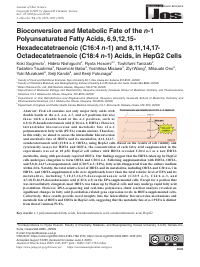
| 抄録 | Fish oil contains not only major fatty acids with double bonds at the n-3, n-6, n-7, and n-9 positions but also those with a double bond at the n-1 position, such as 6,9,12,15-hexadecatetraenoic acid (C16:4 n-1; HDTA). However, intracellular bioconversion and metabolic fate of n-1 polyunsaturated fatty acids (PUFA) remain unclear. Therefore, in this study, we aimed to assess the intracellular bioconversion and metabolic fate of HDTA and its metabolite, 8,11,14,17- octadecatetraenoic acid (C18:4 n-1; ODTA), using HepG2 cells. Based on the results of cell viability and cytotoxicity assays for HDTA and ODTA, the concentration of each fatty acid supplemented in the experiments was set at 10 μM. HepG2 cell culture with HDTA revealed C20:4 n-1 as a new HDTA metabolite, along with previously reported ODTA. Our findings suggest that the HDTA taken up by HepG2 cells undergoes elongation to form ODTA and C20:4 n-1. Following supplementation with HDTA, ODTA, and 5,8,11,14,17-eicosapentaenoic acid (C20:5 n-3; EPA), fatty acids disappeared from the culture medium within 24 h. Notably, the total relative level of HDTA and its metabolites, including ODTA and C20:4 n-1 in HDTA- and ODTA-supplemented cells were significantly lower than the total relative level of EPA and its metabolites, including 7,10,13,16,19-docosapentaenoic acid (C22:5 n-3), C24:6 n-3, and 4,7,10,13,16,19-docosahexaenoic acid (C22:6 n-3) in the EPA-supplemented cells. Except for a portion that was intracellularly elongated, most HDTA was taken up by HepG2 cells and may undergo rapid fatty acid β-oxidation. However, RNA-sequencing and real-time polymerase chain reaction analysis revealed no significant changes in fatty acid β-oxidation–related gene expression levels in HDTA-supplemented cells. Collectively, these results provide novel insights into the intracellular bioconversion mechanisms and metabolic fate of HDTA and ODTA in HepG2 cells, suggesting that the metabolic fate of n-1 PUFA is distinct from that of common PUFA.
|
| キーワード | n-1 polyunsaturated fatty acids
hexadecatetraenoic acid
octadecatetraenoic acid
HepG2
|
| 発行日 | 2025
|
| 出版物タイトル |
Journal of Oleo Science
|
| 巻 | 74巻
|
| 号 | 11号
|
| 出版者 | Japan Oil Chemists' Society
|
| 開始ページ | 1023
|
| 終了ページ | 1032
|
| ISSN | 1345-8957
|
| NCID | AA11503337
|
| 資料タイプ |
学術雑誌論文
|
| 言語 |
英語
|
| OAI-PMH Set |
岡山大学
|
| 著作権者 | © 2025 by Japan Oil Chemists' Society
|
| 論文のバージョン | publisher
|
| PubMed ID | |
| DOI | |
| CRID | |
| Web of Science KeyUT | |
| 関連URL | isVersionOf https://doi.org/
|
| ライセンス | https://creativecommons.org/licenses/by-sa/4.0/
|
| 助成情報 |
( 一般財団法人油脂工業会館 / Foundation, Oil & Fat Industry Kaikan )
|