| ID | 70052 |
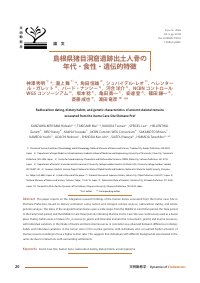
| タイトル(別表記) | Radiocarbon dating, dietary habits, and genetic characteristics of ancient skeletal remains excavated from the Inome Cave Site in Shimane Prefecture
|
| JaLCDOI | |
| フルテキストURL | |
| 著者 |
神澤 秀明
Division of Human Evolution, Paleontology and Anthropology, National Museum of Nature and Science, Tsukuba City, Ibaraki Prefecture
瀧上 舞
Division of Human Evolution, Paleontology and Anthropology, National Museum of Nature and Science, Tsukuba City, Ibaraki Prefecture
角田 恒雄
Department of Legal Medicine, Interdisciplinary Graduate School of Medicine and Engineering, University of Yamanashi
シュパイデル レオ
Center for Interdisciplinary Theoretical and Mathematical Sciences, RIKEN
ヘレンタール ガレット
Department of Genetics, Evolution and Environment, University College London Genetics Institute (UGI), University College London
バード ナンシー
Department of Genetics, Evolution and Environment, University College London Genetics Institute (UGI), University College London
河合 洋介
Genome Medical Science Project, National Institute of Global Health and Medicine, National Institute for Health Security
NCBN コントロール WGS コンソーシアム
坂本 稔
National Museum of Japanese History
亀田 勇一
Division of Human Evolution, Paleontology and Anthropology, National Museum of Nature and Science, Tsukuba City, Ibaraki Prefecture
安達 登
Department of Legal Medicine, Interdisciplinary Graduate School of Medicine and Engineering, University of Yamanashi
篠田 謙一
National Museum of Nature and Science
斎藤 成也
National Institute of Genetics
濵田 竜彦
Research Institute for the Dynamics of Civilizations, Okayama University
|
| 抄録 | This paper reports on the integrative research findings of the human bones excavated from the Inome Cave Site in Shimane Prefecture, based on dietary estimation using carbon and nitrogen isotope analysis, radiocarbon dating, and whole genome analysis. The dates of the analyzed human bones span a wide range, from the Middle to Late Kofun period, the Nara period to the Early Heian period, and the Middle to Late Heian period, indicating that the Inome Cave Site was continuously used as a burial place. Dietary habits were a mixture of C3 resources (C3 plants and terrestrial animals that consumed C3 plants) and marine resources, with individual variations in the intake of marine and terrestrial resources. A correlation was observed between differences in dietary habits and individual variations in the Jomon ratio in the nuclear genome, with individuals who consumed higher amounts of marine resources tending to have a higher Jomon ratio. This suggests that individuals with different backgrounds were buried in the same site due to interactions with surrounding settlements.
|
| キーワード | Inome Cave Site
human bone
radiocarbon dating
dietary habits
ancient genome
|
| Amo Type | 論文 (Research article)
|
| 出版物タイトル |
文明動態学
|
| 発行日 | 2026-03
|
| 巻 | 5巻
|
| 出版者 | 岡山大学文明動態学研究所
|
| 開始ページ | 20
|
| 終了ページ | 39
|
| ISSN | 2436-8326
|
| 資料タイプ |
学術雑誌論文
|
| 言語 |
日本語
|
| 著作権者 | © 2025 by RIDC
|
| 論文のバージョン | publisher
|
| 助成情報 |
18H05505:
ゲノム配列を核としたヤポネシア人の起源と成立の解明
( 独立行政法人日本学術振興会 / Japan Society for the Promotion of Science )
18H05507:
古代人ゲノム配列解析にもとづくヤポネシア人進化の解明
( 独立行政法人日本学術振興会 / Japan Society for the Promotion of Science )
18H05509:
考古学データによるヤポネシア人の歴史の解明
( 独立行政法人日本学術振興会 / Japan Society for the Promotion of Science )
23H04839:
同位体分析による先史人骨の年代・食性復元・移動の研究
( 独立行政法人日本学術振興会 / Japan Society for the Promotion of Science )
23H04843:
本州・四国・九州域における先史人類および文化の形成
( 独立行政法人日本学術振興会 / Japan Society for the Promotion of Science )
|