| ID | 46228 |
| FullText URL | |
| Title Alternative | The usefulness of quail as Laboratory animal
|
| Author |
Takahashi, Shinji
Shimizu, Akira
Kawashima, Takaharu
|
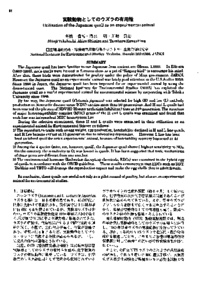
| Abstract | The Japanese quail has been familiar to our Japanese from ancient era (Heian, 1,000). In Edo era (1603-1868), male quails were housed in Samurai class as a pet of "Singing bird" to encourage his mind. After that, these birds were domesticated for poultry under the policy of Meiji government, JAPAN. However, the Japanese quail as an experimental animal was lately paid attention in the U.S.A after 1950. Since 1960 in Japan, the Japanese quail has been improved for an experimental animal by using the domesticated ones. The National Institute for Environmental Studies (NIES) has exploited the Japanese quail as a useful experimental animal for environmental science by cooperating with Tohoku University since 1980. By the way, the Japanese quail (Coturnix japonica) was selected for high (H) and low (L) antibody production to Newcastle disease virus (NDV) vaccine more than 50 generations. And H and L quails had been reached the plateau of NDV-HI (Haemo-agglutinin Inhibition) titer at 24(th) generation. The structure of major histocompatibility complex (MHC) genes of the H and L quails was examined and found that each line was independent MHC homozygous line. During the selection experiment, these H and L quails were examined in their utilization as an experimental animal for Environmental Science as follows: 1) The reproductive traits such as egg weight, egg production, hatchability declined in H and L line quails, and H line became extinct at 53 generation due to inbreeding depression. However, L line has been bred as inbred quail for avian experimental animal, because of hatchability recovery happened at 43 generation. 2) Among the 4 species (mice, rat, hamster, quail), the Japanese quail showed highest sensitivity to NO(2). On the contrary, the sensitivity to O(3) was lowest in quails. It has been suggested that toxic mechanisms of those gases are different from one another. 3) The environmental hormone (Endocrine disrupting chemicals, EDCs) was examined in the hybrid egg of quails in accordance with the OECD guideline. These results demonstrate that EDCs such as DDT, Dieldrin and TBTO will damage the reproductive organs and make the egg shells thin in adult female. In conclusion, these quails are useful not only as a pilot animal of poultry, but also as an experimental animal for environmental studies.
|
| Note | 特別講演要旨 (Summary of Special Lecture)
|
| Published Date | 2011-05
|
| Publication Title |
岡山実験動物研究会報
|
| Publication Title Alternative | Proceedings of Okayama Association for Laboratory Animal Science
|
| Volume | volume27
|
| Publisher | 岡山実験動物研究会
|
| Publisher Alternative | Okayama Association for Laboratory Animal Science
|
| Start Page | 16
|
| End Page | 21
|
| Content Type |
Others
|
| language |
Japanese
|
| File Version | publisher
|
| Refereed |
False
|
| Eprints Journal Name | poalas
|