| ID | 66947 |
| FullText URL | |
| Author |
Nagao, Shoji
Department of Obstetrics and Gynecology, Faculty of Medicine, Dentistry and Pharmaceutical Sciences, Okayama University
Tamura, Jun
Department of Biostatistics, Yokohama City University School of Medicine
Shibutani, Takashi
Department of Gynecologic Oncology, Hyogo Cancer Center
Miwa, Maiko
Department of Gynecologic Oncology, Saitama Medical University International Medical Center
Kato, Tomoyasu
Department of Gynecologic Oncology, National Cancer Center Hospital
Shikama, Ayumi
Department of Obstetrics and Gynecology, Graduate School of Comprehensive Human Sciences, University of Tsukuba
Takei, Yuji
Department of Obstetrics and Gynecology, Jichi Medical University
Kamiya, Natsuko
Department of Obstetrics and Gynecology, Yokohama City University School of Medicine
Inoue, Naoki
Department of Obstetrics and Gynecology, Gunma University
Nakamura, Kazuto
Department of Gynecologic Oncology, Gunma Prefectural Cancer Center
Inoue, Aya
Department of Obstetrics and Gynecology, Ehime University School of Medicine
Yamamoto, Koji
Department of Biostatistics, Yokohama City University School of Medicine
Fujiwara, Keiichi
Department of Gynecologic Oncology, Saitama Medical University International Medical Center
Suzuki, Mitsuaki
Department of Obstetrics and Gynecology, Shin-Yurigaoka General Hospital
|
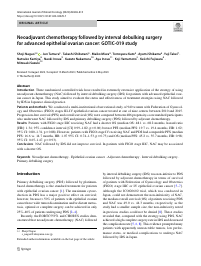
| Abstract | Introduction Three randomized controlled trials have resulted in extremely extensive application of the strategy of using neoadjuvant chemotherapy (NAC) followed by interval debulking surgery (IDS) for patients with advanced epithelial ovarian cancer in Japan. This study aimed to evaluate the status and effectiveness of treatment strategies using NAC followed by IDS in Japanese clinical practice.
Patients and methods We conducted a multi-institutional observational study of 940 women with Federation of Gynecology and Obstetrics (FIGO) stages III–IV epithelial ovarian cancer treated at one of nine centers between 2010 and 2015. Progression-free survival (PFS) and overall survival (OS) were compared between 486 propensity-score matched participants who underwent NAC followed by IDS and primary debulking surgery (PDS) followed by adjuvant chemotherapy. Results Patients with FIGO stage IIIC receiving NAC had a shorter OS (median OS: 48.1 vs. 68.2 months, hazard ratio [HR]: 1.34; 95% confidence interval [CI] 0.99–1.82, p = 0.06) but not PFS (median PFS: 19.7 vs. 19.4 months, HR: 1.02; 95% CI: 0.80–1.31, p = 0.88). However, patients with FIGO stage IV receiving NAC and PDS had comparable PFS (median PFS: 16.6 vs. 14.7 months, HR: 1.07 95% CI: 0.74–1.53, p = 0.73) and OS (median PFS: 45.2 vs. 35.7 months, HR: 0.98; 95% CI: 0.65–1.47, p = 0.93). Conclusions NAC followed by IDS did not improve survival. In patients with FIGO stage IIIC, NAC may be associated with a shorter OS. |
| Keywords | Neoadjuvant chemotherapy
Epithelial ovarian cancer
Adjuvant chemotherapy
Interval debulking surgery
Primary debulking surgery
|
| Note | The version of record of this article, first published in International Journal of Clinical Oncology, is available online at Publisher’s website: http://dx.doi.org/10.1007/s10147-023-02329-7
|
| Published Date | 2023-05-04
|
| Publication Title |
International Journal of Clinical Oncology
|
| Volume | volume28
|
| Issue | issue6
|
| Publisher | Springer Science and Business Media LLC
|
| Start Page | 804
|
| End Page | 815
|
| ISSN | 1341-9625
|
| NCID | AA11086579
|
| Content Type |
Journal Article
|
| language |
English
|
| OAI-PMH Set |
岡山大学
|
| Copyright Holders | © The Author(s) 2023
|
| File Version | publisher
|
| PubMed ID | |
| DOI | |
| Web of Science KeyUT | |
| Related Url | isVersionOf https://doi.org/10.1007/s10147-023-02329-7
|
| License | http://creativecommons.org/licenses/by/4.0/
|
| Citation | Nagao, S., Tamura, J., Shibutani, T. et al. Neoadjuvant chemotherapy followed by interval debulking surgery for advanced epithelial ovarian cancer: GOTIC-019 study. Int J Clin Oncol 28, 804–815 (2023). https://doi.org/10.1007/s10147-023-02329-7
|
| Funder Name |
Okayama University
|