| ID | 48670 |
| JaLCDOI | |
| FullText URL | |
| Author |
Iida, Tadayuki
Chikamura, Chiho
Ishikawa, Hiroaki
Aoi, Satomi
Ikeda, Hiromi
Harada, Toshihide
Katada, Kazuhiro
Ishizaki, Fumiko
Yatsuya, Hiroshi
Ono, Yuichiro
|
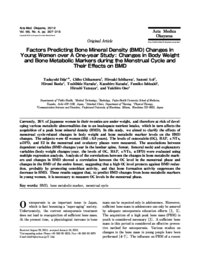
| Abstract | Currently, 26% of Japanese women in their twenties are under weight, and therefore at risk of developing
various metabolic abnormalities due to an inadequate nutrient intake, which in turn affects the acquisition of a peak bone mineral density (BMD). In this study, we aimed to clarify the effects of menstrual cycle-related changes in body weight and bone metabolic marker levels on the BMD changes. The subjects were 42 women (19.6±0.8 years). The levels of osteocalcin (OC), BAP, s-NTx, u-DPD, and E2 in the menstrual and ovulatory phases were measured. The associations between dependent variables (BMD changes/year in the lumbar spine, femur, femoral neck) and explanatory variables (body weight changes/year, the levels of OC, BAP, s-NTx, u-DPD) were evaluated using multiple regression analysis. Analysis of the correlations between the changes in bone metabolic markers
and changes in BMD showed a correlation between the OC level in the menstrual phase and changes in the BMD of the entire femur, suggesting that a high OC level protects against BMD reduction,
probably by promoting osteoblast activity, and that bone formation activity suppresses the decrease in BMD. These results suggest that, to predict BMD changes from bone metabolic markers in young women, it is necessary to measure OC levels in the menstrual phase.
|
| Keywords | BMD
bone metabolic marker
menstrual cycle
|
| Amo Type | Original Article
|
| Publication Title |
Acta Medica Okayama
|
| Published Date | 2012-08
|
| Volume | volume66
|
| Issue | issue4
|
| Publisher | Okayama University Medical School
|
| Start Page | 307
|
| End Page | 315
|
| ISSN | 0386-300X
|
| NCID | AA00508441
|
| Content Type |
Journal Article
|
| language |
English
|
| Copyright Holders | CopyrightⒸ 2012 by Okayama University Medical School
|
| File Version | publisher
|
| Refereed |
True
|
| PubMed ID | |
| Web of Science KeyUT |