| ID | 70098 |
| FullText URL | |
| Author |
Yamamura, Yuka
Department of Epidemiology, Okayama University Faculty of Medicine, Dentistry, and Pharmaceutical Sciences
Hongo, Takashi
Department of Emergency, Critical Care, and Disaster Medicine, Okayama University Faculty of Medicine, Dentistry, and Pharmaceutical Sciences
Yumoto, Tetsuya
Department of Emergency, Critical Care, and Disaster Medicine, Okayama University Faculty of Medicine, Dentistry, and Pharmaceutical Sciences
ORCID
Kaken ID
publons
Sasai, Fumiya
Department of Epidemiology, Okayama University Faculty of Medicine, Dentistry, and Pharmaceutical Sciences
Tokioka, Kohei
Department of Emergency, Critical Care, and Disaster Medicine, Okayama University Faculty of Medicine, Dentistry, and Pharmaceutical Sciences
Obara, Takafumi
Department of Emergency, Critical Care, and Disaster Medicine, Okayama University Faculty of Medicine, Dentistry, and Pharmaceutical Sciences
Nojima, Tsuyoshi
Department of Emergency, Critical Care, and Disaster Medicine, Okayama University Faculty of Medicine, Dentistry, and Pharmaceutical Sciences
ORCID
Kaken ID
publons
researchmap
Kanda, Jun
Emergency and Critical Care Medicine, Nippon Medical School Musashikosugi Hospital
Yokobori, Shoji
Department of Emergency and Critical Care Medicine, Nippon Medical School
Naito, Hiromichi
Department of Emergency, Critical Care, and Disaster Medicine, Okayama University Faculty of Medicine, Dentistry, and Pharmaceutical Sciences
ORCID
Kaken ID
publons
Yorifuji, Takashi
Department of Epidemiology, Okayama University Faculty of Medicine, Dentistry, and Pharmaceutical Sciences
ORCID
Kaken ID
publons
researchmap
Nakao, Atsunori
Department of Emergency, Critical Care, and Disaster Medicine, Okayama University Faculty of Medicine, Dentistry, and Pharmaceutical Sciences
Kaken ID
|
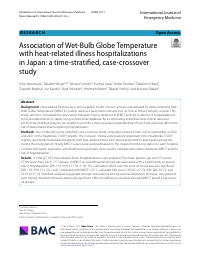
| Abstract | Background Heat-related illnesses are a serious public health concern and are exacerbated by global warming. Wet-Bulb Globe Temperature (WBGT) is widely used as a heat stress indicator, but its clinical impact remains unclear. This study aimed to investigate the association between hourly variations in WBGT and the incidence of hospitalizations for heat-related illness in Japan using a nationwide database. By incorporating individual-level clinical data and performing stratified analyses, we sought to provide a more granular understanding of how heat exposure affects the risk of heat-related illness requiring hospitalization.
Methods We conducted a time-stratified, case-crossover study using data collected from July to September in 2020 and 2021 in the Heatstroke STUDY registry. The inclusion criteria were patients registered in the Heatstroke STUDY registry, specifically hospitalized patients with heat-related illness who were transported to participating hospitals during the study period. Hourly WBGT values were assigned based on the nearest monitoring station to each hospital. Conditional logistic regression and distributed lag models were used to estimate associations between WBGT and the risk of hospitalization. Results A total of 1,653 heat-related illness hospitalizations were analyzed. The mean patient age was 67.9 years; 67.6% were male. Each 1 °C increase in WBGT at onset (hospital arrival) was associated with a significantly increased risk of hospitalization (OR 1.10, 95% CI: 1.05–1.15). The cumulative effect over the prior six hours was also significant (OR 1.56, 95% CI: 1.50–1.62). Compared with WBGT < 25 °C, adjusted ORs were 3.39 (25–27 °C), 8.81 (28–30 °C), and 22.10 (≥ 31 °C). Stratified analyses suggested stronger associations among several subgroups; however, only patients with mental disorders showed statistically significant effect modification, whereas elevated WBGT posed a risk across all groups. Conclusions Higher WBGT levels were associated with an increased risk of heat-related hospitalization. Although the effect appeared greater in some subgroups, only patients with mental disorders demonstrated statistically significant effect modification, suggesting elevated WBGT confers risk broadly. |
| Keywords | Wet-Bulb Globe Temperature
Heat stroke
Heat related illness
Global warming
|
| Published Date | 2026-01-05
|
| Publication Title |
International Journal of Emergency Medicine
|
| Volume | volume19
|
| Issue | issue1
|
| Publisher | Springer Science and Business Media LLC
|
| Start Page | 11
|
| ISSN | 1865-1380
|
| Content Type |
Journal Article
|
| language |
English
|
| OAI-PMH Set |
岡山大学
|
| Copyright Holders | © The Author(s) 2025.
|
| File Version | publisher
|
| PubMed ID | |
| DOI | |
| Web of Science KeyUT | |
| Related Url | isVersionOf https://doi.org/10.1186/s12245-025-01112-x
|
| License | http://creativecommons.org/licenses/by-nc-nd/4.0/
|
| Citation | Yamamura, Y., Hongo, T., Yumoto, T. et al. Association of Wet-Bulb Globe Temperature with heat-related illness hospitalizations in Japan: a time-stratified, case-crossover study. Int J Emerg Med 19, 11 (2026). https://doi.org/10.1186/s12245-025-01112-x
|
| 助成情報 |
( Chugoku Occupational Health Association )
|