| ID | 70749 |
| FullText URL | |
| Author |
Nishii, Yuichi
Graduate School of Environmental, Life, Natural Science and Technology, Okayama University
Araki, Daichi
Graduate School of Environmental, Life, Natural Science and Technology, Okayama University
Saraumi, Mitsuru
Graduate School of Environmental, Life, Natural Science and Technology, Okayama University
Takahashi, Taku
Graduate School of Environmental, Life, Natural Science and Technology, Okayama University
ORCID
Kaken ID
researchmap
|
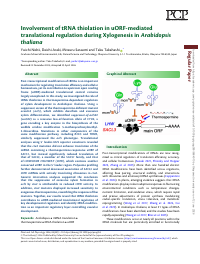
| Abstract | Post-transcriptional modification of tRNAs is an important mechanism for regulating translation efficiency and cellular homeostasis, yet its contribution to upstream open reading frame (uORF)-mediated translational control remains largely unexplored. In this study, we investigated the role of tRNA thiolation in thermospermine-dependent regulation of xylem development in Arabidopsis thaliana. Using a suppressor screen of the thermospermine-deficient mutant acaulis5 (acl5), which exhibits dwarfism and excessive xylem differentiation, we identified suppressor-of-acl502 (sac502) as a recessive loss-of-function allele of CTU2, a gene encoding a key enzyme in the biosynthesis of the wobble uridine modification 5-methoxycarbonylmethyl-2-thiouridine. Mutations in other components of the same modification pathway, including ROL5 and TRM9, similarly suppressed the acl5 phenotype. Translational analyses using 5′ leader-GUS reporter constructs revealed that the ctu2 mutation did not enhance translation of the mRNA containing a thermospermine-responsive uORF of SAC51, but instead significantly reduced translation of that of SACL3, a member of the SAC51 family, and that of LONESOME HIGHWAY (LHW), which contains another conserved uORF in the 5′ leader region. Polysome profiling further demonstrated decreased association of SACL3 and LHW mRNAs with actively translating ribosomes in ctu2. Genetic interaction analyses supported the conclusion that the suppression of excessive xylem formation in acl5 by ctu2 is attributable to reduced LHW activity. In addition, ctu2 mutants displayed increased sensitivity to exogenous thermospermine, resembling the response of lhw mutants. Together, our results reveal that tRNA thiolation contributes to uORF-mediated translational regulation of key developmental regulators and identify tRNA modification as an important regulatory layer controlling vascular development.
|
| Keywords | Arabidopsis
mRNA translation
thermospermine
tRNA thiolation
uOR
|
| Published Date | 2026-04-28
|
| Publication Title |
Plant and Cell Physiology
|
| Publisher | Oxford University Press (OUP)
|
| Start Page | pcag055
|
| ISSN | 0032-0781
|
| NCID | AA0077511X
|
| Content Type |
Journal Article
|
| language |
English
|
| OAI-PMH Set |
岡山大学
|
| Copyright Holders | © The Author(s) 2026.
|
| File Version | publisher
|
| PubMed ID | |
| DOI | |
| Related Url | isVersionOf https://doi.org/10.1093/pcp/pcag055
|
| License | https://creativecommons.org/licenses/by/4.0/
|
| Citation | Yuichi Nishii, Daichi Araki, Mitsuru Saraumi, Taku Takahashi, Involvement of tRNA thiolation in uORF-mediated translational regulation during Xylogenesis in Arabidopsis thaliana, Plant and Cell Physiology, 2026;, pcag055, https://doi.org/10.1093/pcp/pcag055
|
| 助成情報 |
22K06281:
シロイヌナズナの応答変異株を用いたサーモスペルミンの作用機構の解明
( 独立行政法人日本学術振興会 / Japan Society for the Promotion of Science )
25K09663:
植物におけるサーモスペルミンの作用標的の実体解明
( 独立行政法人日本学術振興会 / Japan Society for the Promotion of Science )
( 公益財団法人両備檉園記念財団 / Ryobi-Teien Memory Foundation )
|