| ID | 70230 |
| FullText URL | |
| Author |
Nakayama, Rie
Department of Cardiovascular Medicine, Dentistry and Pharmaceutical Science, Okayama University Graduate School of Medicine
Takaya, Yoichi
Department of Cardiovascular Medicine, Dentistry and Pharmaceutical Science, Okayama University Graduate School of Medicine
ORCID
Kaken ID
Nakashima, Mitsutaka
Department of Cardiovascular Medicine, Dentistry and Pharmaceutical Science, Okayama University Graduate School of Medicine
Nishihara, Takahiro
Department of Cardiovascular Medicine, Dentistry and Pharmaceutical Science, Okayama University Graduate School of Medicine
Toh, Norihisa
Department of Cardiovascular Medicine, Dentistry and Pharmaceutical Science, Okayama University Graduate School of Medicine
Kaken ID
researchmap
Toru, Miyoshi
Department of Cardiovascular Medicine, Dentistry and Pharmaceutical Science, Okayama University Graduate School of Medicine
Nakamura, Kazufumi
Department of Cardiovascular Medicine, Dentistry and Pharmaceutical Science, Okayama University Graduate School of Medicine
Kaken ID
publons
researchmap
Yuasa, Shinsuke
Department of Cardiovascular Medicine, Dentistry and Pharmaceutical Science, Okayama University Graduate School of Medicine
|
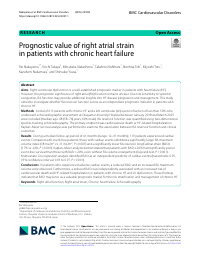
| Abstract | Aims Right ventricular dysfunction is a well-established prognostic marker in patients with heart failure (HF). However, the prognostic significance of right atrial (RA) function remains unclear. Given its sensitivity to systemic congestion, RA function may provide additional insights into HF disease progression and management. This study aimed to investigate whether RA reservoir function serves as an independent prognostic indicator in patients with chronic HF.
Methods A total of 613 patients with chronic HF and a left ventricular (LV) ejection fraction of less than 50% who underwent echocardiographic assessment at Okayama University Hospital between January 2018 and March 2023 were included (median age: 68 (58–76) years; 69% male). RA reservoir function was quantified using two-dimensional speckle-tracking echocardiography. The primary endpoint was cardiovascular death or HF-related hospitalization. Kaplan–Meier survival analysis was performed to examine the association between RA reservoir function and clinical outcomes. Results During a median follow-up period of 41 months (range: 12–91 months), 119 patients experienced cardiac events. Compared with event-free patients, those with cardiac events exhibited a significantly larger RA maximum volume index (38 mL/m2 vs. 31 mL/m2, P < 0.001) and a significantly lower RA reservoir longitudinal strain (RASr) (17% vs. 22%, P < 0.001). Kaplan–Meier analysis demonstrated that patients with RASr ≤ 20% had significantly poorer event-free survival than those with RASr > 20%, even without RA volume enlargement (log-rank test, P < 0.001). Multivariate Cox regression analysis identified RASr as an independent predictor of cardiac events (hazard ratio: 0.95, 95% confidence interval: 0.93 to 0.97, P < 0.001). Conclusions In patients who experienced adverse cardiac events, a reduced RASr and an increased RA maximum volume were observed. Furthermore, a reduced RASr was independently associated with an increased risk of cardiovascular death and HF-related hospitalization in patients with chronic HF and LV dysfunction. These findings indicate that RASr may serve as a valuable prognostic marker for the risk stratification and management of chronic HF. |
| Keywords | Right atrial function
Right atrial strain
Chronic heart failure
Echocardiography
|
| Published Date | 2025-11-22
|
| Publication Title |
BMC Cardiovascular Disorders
|
| Volume | volume25
|
| Issue | issue1
|
| Publisher | Springer Science and Business Media LLC
|
| Start Page | 908
|
| ISSN | 1471-2261
|
| Content Type |
Journal Article
|
| language |
English
|
| OAI-PMH Set |
岡山大学
|
| Copyright Holders | © The Author(s) 2025.
|
| File Version | publisher
|
| PubMed ID | |
| DOI | |
| Web of Science KeyUT | |
| Related Url | isVersionOf https://doi.org/10.1186/s12872-025-05307-1
|
| License | http://creativecommons.org/licenses/by-nc-nd/4.0/
|
| Citation | Nakayama, R., Takaya, Y., Nakashima, M. et al. Prognostic value of right atrial strain in patients with chronic heart failure. BMC Cardiovasc Disord 25, 908 (2025). https://doi.org/10.1186/s12872-025-05307-1
|