| ID | 71081 |
| FullText URL | |
| Author |
Ouddoud, Hanane
Department of Health Data Science, Graduate School of Medicine, Dentistry, and Pharmaceutical Sciences, Okayama University
Lescano, Judah Israel Ong
Department of Health Data Science, Graduate School of Medicine, Dentistry, and Pharmaceutical Sciences, Okayama University
Belangoy, Keith Pardillada
Department of Health Data Science, Graduate School of Medicine, Dentistry, and Pharmaceutical Sciences, Okayama University
Harada, Ko
Brookdale Department of Geriatrics and Palliative Medicine, Icahn School of Medicine at Mount Sinai
Hagiya, Hideharu
Department of Infectious Diseases, Okayama University Hospital
ORCID
Kaken ID
researchmap
Vu, Quynh Thi
Faculty of Pharmacy, Haiphong University of Medicine and Pharmacy
Iwata, Naohiro
Department of Pharmacy, Okayama University Hospital
Higashionna, Tsukasa
Department of Pharmacy, Okayama University Hospital
Takeda, Tatsuaki
Department of Education and Research Center for Clinical Pharmacy, Faculty of Pharmaceutical Sciences, Okayama University
ORCID
Kaken ID
researchmap
Zamami, Yoshito
Department of Pharmacy, Okayama University Hospital
ORCID
Kaken ID
publons
researchmap
Koyama, Toshihiro
Department of Health Data Science, Graduate School of Medicine, Dentistry, and Pharmaceutical Sciences, Okayama University
ORCID
Kaken ID
publons
researchmap
|
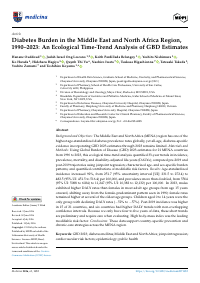
| Abstract | Background and Objectives: The Middle East and North Africa (MENA) region has one of the highest age-standardized diabetes prevalence rates globally, yet all-age, diabetes-specific evidence incorporating GBD 2023 estimates through 2023 remains limited. Materials and Methods: Using Global Burden of Disease (GBD) 2023 estimates for 21 MENA countries from 1990 to 2023, this ecological time-trend analysis quantified 33-year trends in incidence, prevalence, mortality, and disability-adjusted life-years (DALYs); compared pre-2019 and post-2019 trajectories using joinpoint regression; characterized age- and sex-specific burden patterns; and quantified contributions of modifiable risk factors. Results: Age-standardized incidence increased 92%, from 251.7 (95% uncertainty interval [UI]: 231.5 to 272.4) to 482.5 (95% UI: 451.5 to 516.4) per 100,000, and prevalence more than doubled, from 5564 (95% UI: 5088 to 6024) to 11,247 (95% UI: 10,382 to 12,132) per 100,000. In 2023, males exhibited higher DALY rates than females in most adult age groups from age 15 years onward, shifting away from the female-predominant pattern seen in 1990; female rates remained higher at several of the oldest age groups. Children aged 0 to 14 years were the only group with declining DALY rates (−52% to −57%). Post-2019 incidence was higher in 15 of 21 countries, and six countries had higher DALY trends with non-overlapping confidence intervals. Because we only have four to five years of data, these short trends are preliminary and require care when evaluating. High body-mass index was the leading modifiable risk factor. Conclusions: These data support country-specific prevention and chronic-care strategies across the MENA region.
|
| Keywords | GBD 2023
diabetes mellitus
Middle East and North Africa
joinpoint regression
cardiovascular risk factors
epidemiology
public health
|
| Published Date | 2026-07-13
|
| Publication Title |
Medicina
|
| Volume | volume62
|
| Issue | issue7
|
| Publisher | MDPI AG
|
| Start Page | 1352
|
| ISSN | 1648-9144
|
| Content Type |
Journal Article
|
| language |
English
|
| OAI-PMH Set |
岡山大学
|
| Copyright Holders | © 2026 by the authors.
|
| File Version | publisher
|
| PubMed ID | |
| DOI | |
| Web of Science KeyUT | |
| Related Url | isVersionOf https://doi.org/10.3390/medicina62071352
|
| License | https://creativecommons.org/licenses/by/4.0/
|
| Citation | Ouddoud, H.; Lescano, J.I.O.; Belangoy, K.P.; Nishimura, Y.; Harada, K.; Hagiya, H.; Vu, Q.T.; Iwata, N.; Higashionna, T.; Takeda, T.; et al. Diabetes Burden in the Middle East and North Africa Region, 1990–2023: An Ecological Time-Trend Analysis of GBD Estimates. Medicina 2026, 62, 1352. https://doi.org/10.3390/medicina62071352
|
| 助成情報 |
26K02613:
国際医療データサイエンスで創る健康格差是正のための予測モデル構築
( 独立行政法人日本学術振興会 / Japan Society for the Promotion of Science )
( 国立大学法人岡山大学 / Okayama university )
|