| ID | 70537 |
| FullText URL | |
| Author |
Fujii, Yuki
Department of Endoscopy, Okayama University Hospital
Ueki, Toru
Department of Gastroenterology, Fukuyama City Hospital
Himei, Hitomi
Department of Gastroenterology, Hiroshima City Hiroshima Citizens Hospital
Sakakihara, Ichiro
Department of Gastroenterology, Kagawa Prefectural Central Hospital
Ueta, Eijiro
Department of Gastroenterology, National Hospital Organization Iwakuni Clinical Center
Toyokawa, Tatsuya
Department of Gastroenterology, NHO Fukuyama Medical Center
Harada, Ryo
Department of Gastroenterology, Japanese Red Cross Okayama Hospital
Ogawa, Taiji
Department of Gastroenterology, Tsuyama Chuo Hospital
Tomoda, Takeshi
Department of Gastroenterology, Okayama City Hospital
Kato, Hironari
Department of Gastroenterology, Okayama City Hospital
Mitsuhashi, Toshiharu
Center for Innovative Clinical Medicine, Medical Development Field, Okayama University
Kaken ID
researchmap
Sato, Ryosuke
Department of Gastroenterology and Hepatology, Okayama University Hospital
Matsumi, Akihiro
Department of Gastroenterology and Hepatology, Okayama University Hospital
Miyamoto, Kazuya
Department of Gastroenterology and Hepatology, Okayama University Hospital
Uchida, Daisuke
Department of Gastroenterology and Hepatology, Okayama University Hospital
ORCID
Kaken ID
researchmap
Horiguchi, Shigeru
Department of Gastroenterology and Hepatology, Okayama University Hospital
Tsutsumi, Koichiro
Department of Gastroenterology and Hepatology, Okayama University Hospital
ORCID
Kaken ID
researchmap
Otsuka, Motoyuki
Department of Gastroenterology and Hepatology, Okayama University Hospital
|
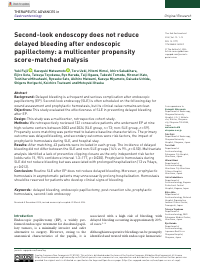
| Abstract | Background: Delayed bleeding is a frequent and serious complication after endoscopic papillectomy (EP). Second-look endoscopy (SLE) is often scheduled on the following day for wound assessment and prophylactic hemostasis, but its clinical value remains unclear.
Objectives: This study evaluated the effectiveness of SLE in preventing delayed bleeding after EP. Design: This study was a multicenter, retrospective cohort study. Methods: We retrospectively reviewed 132 consecutive patients who underwent EP at nine high-volume centers between 2003 and 2024 (SLE group, n = 73; non-SLE group, n = 59). Propensity score matching was performed to balance baseline characteristics. The primary outcome was delayed bleeding, and secondary outcomes were risk factors, the impact of prophylactic hemostasis during SLE, and hospital stay. Results: After matching, 43 patients were included in each group. The incidence of delayed bleeding did not differ between the SLE and non-SLE groups (14% vs 9%, p = 0.50). Multivariate analysis identified a lack of preventive clipping closure as the only independent risk factor (odds ratio 15, 95% confidence interval 1.3–177, p = 0.030). Prophylactic hemostasis during SLE did not reduce bleeding but was associated with prolonged hospitalization (13 vs 9 days, p = 0.012). Conclusion: Routine SLE after EP does not reduce delayed bleeding. Moreover, prophylactic hemostasis in asymptomatic patients may unnecessarily prolong hospitalization. Hemostasis should be reserved for patients who develop clinical signs of bleeding. |
| Keywords | delayed bleeding
endoscopic papillectomy
post-resection site
prophylactic hemostasis
second-look endoscopy
|
| Published Date | 2026-05
|
| Publication Title |
Therapeutic Advances in Gastroenterology
|
| Volume | volume19
|
| Publisher | SAGE Publications
|
| ISSN | 1756-2848
|
| Content Type |
Journal Article
|
| language |
English
|
| OAI-PMH Set |
岡山大学
|
| Copyright Holders | © The Author(s), 2026.
|
| File Version | publisher
|
| PubMed ID | |
| DOI | |
| Web of Science KeyUT | |
| Related Url | isVersionOf https://doi.org/10.1177/17562848261439231
|
| License | https://creativecommons.org/licenses/by-nc/4.0/
|
| Citation | Fujii Y, Matsumoto K, Ueki T, et al. Second-look endoscopy does not reduce delayed bleeding after endoscopic papillectomy: a multicenter propensity score-matched analysis. Therapeutic Advances in Gastroenterology. 2026;19. doi:10.1177/17562848261439231
|
| 助成情報 |
24K18948:
人工知能を用いたEUS-FNBにおけるがん遺伝子パネル検査への検体適正度評価装置の開発
( 独立行政法人日本学術振興会 / Japan Society for the Promotion of Science )
|