| ID | 70398 |
| FullText URL | |
| Author |
Washida, Naoyuki
Kataoka, Moe
Department of Applied Chemistry and Biotechnology, Faculty of Engineering, Okayama University
Brun, Anna R.
Applied Cell Biology, Graduate School of Interdisciplinary Science and Engineering in Health Systems, Okayama University
Takezaki, Uryu
Applied Cell Biology, Graduate School of Interdisciplinary Science and Engineering in Health Systems, Okayama University
Hijikawa, Ko
Department of Applied Chemistry and Biotechnology, Faculty of Engineering, Okayama University
Yamauchi, Haruki
Applied Cell Biology, Graduate School of Interdisciplinary Science and Engineering in Health Systems, Okayama University
Ohtsuka, Satomi
Applied Cell Biology, Graduate School of Interdisciplinary Science and Engineering in Health Systems, Okayama University
Magari, Masaki
Applied Cell Biology, Graduate School of Interdisciplinary Science and Engineering in Health Systems, Okayama University
Kaken ID
publons
researchmap
Morishita, Ryo
CellFree Sciences Co., Ltd.
Tokumitsu, Hiroshi
Applied Cell Biology, Graduate School of Interdisciplinary Science and Engineering in Health Systems, Okayama University
ORCID
Kaken ID
publons
researchmap
|
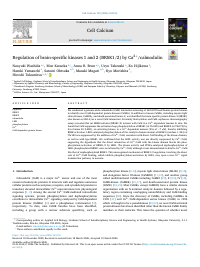
| Abstract | We conducted a genome-wide calmodulin (CaM) interaction screening of 462 GST-fused human protein kinases to identify novel CaM-dependent protein kinases (CaMKs). In addition to known CaMKs, including myosin light chain kinases, CaMK2γ, and death-associated kinase 2, we identified the brain-specific protein kinase 2 (BRSK2, also known as SAD-A) as a novel CaM interactant. Proximity biotinylation and CaM–sepharose chromatography assays revealed that rat BRSK isoforms (BRSK1/2) interact with CaM in a Ca2+-dependent manner in vitro. We found that CaM suppresses the activation-loop phosphorylation of BRSK1 (at Thr189) and BRSK2 (at Thr175) by liver kinase B1 (LKB1), an activating kinase, in a Ca2+-dependent manner (IC50 of ∼7 µM), thereby inhibiting BRSK activation. LKB1-catalyzed phosphorylation of the catalytic domain mutant of BRSK1 (residues 1–294) at Thr189 was suppressed by the addition of Ca2+/CaM, consistent with direct CaM binding of the kinase domain, as well as wild-type BRSK1. We confirmed that the LKB1 activity was not directly suppressed by Ca2+/CaM, supporting the hypothesis that the direct interaction of Ca2+/CaM with the kinase domain blocks the phosphorylation/activation of BRSK1/2 by LKB1. The kinase activity and PP2Cα-catalyzed dephosphorylation of LKB1-phosphorylated BRSK1 were not altered by Ca2+/CaM, although it was demonstrated to bind to Ca2+/CaM like that of unphosphorylated BRSK1. This unrecognized mechanism of BRSK1/2 regulation, involving the direct role of Ca2+/CaM binding, which inhibits phosphorylation/activation by LKB1, may open a new Ca2+ signal transduction pathway in neurons.
|
| Keywords | BRSK1
BRSK2
calmodulin
LKB1
phosphorylation
Ca2+
CaM-dependent protein kinase
|
| Published Date | 2026-05
|
| Publication Title |
Cell Calcium
|
| Volume | volume135
|
| Publisher | Elsevier BV
|
| Start Page | 103134
|
| ISSN | 0143-4160
|
| NCID | AA00142099
|
| Content Type |
Journal Article
|
| language |
English
|
| OAI-PMH Set |
岡山大学
|
| Copyright Holders | © 2026 The Author(s).
|
| File Version | publisher
|
| PubMed ID | |
| DOI | |
| Related Url | isVersionOf https://doi.org/10.1016/j.ceca.2026.103134
|
| License | http://creativecommons.org/licenses/by-nc/4.0/
|
| 助成情報 |
25K09566:
新たなカルモデュリン制御リン酸化・脱リン酸化酵素の発見とシグナル伝達解析
( 独立行政法人日本学術振興会 / Japan Society for the Promotion of Science )
25K18423:
CaMKKシグナル伝達の分子機構解明とそれに立脚した分子ツールの開発
( 独立行政法人日本学術振興会 / Japan Society for the Promotion of Science )
|