| ID | 71056 |
| FullText URL | |
| Author |
Kobayashi, Tomoko
Department of Urology, Okayama University Hospital
Moriwake, Takatoshi
Department of Urology, Okayama University Hospital
Tominaga, Yusuke
Department of Urology, Okayama University Hospital
Ozaki, Nariaki
Department of Urology, Okayama University Hospital
Horii, Satoshi
Department of Urology, Okayama University Hospital
Tsuboi, Ichiro
Department of Urology, Okayama University Hospital
Yoshinaga, Kasumi
Department of Urology, Okayama University Hospital
Yamanoi, Tomoaki
Department of Urology, Okayama University Hospital
Kawada, Tatsushi
Department of Urology, Okayama University Hospital
Sadahira, Takuya
Center for Innovative Clinical Medicine, Okayama University Hospital
ORCID
Kaken ID
researchmap
Iwata, Takehiro
Department of Urology, Okayama University Hospital
Kaken ID
Katayama, Satoshi
Department of Urology, Okayama University Hospital
Nishimura, Shingo
Department of Urology, Okayama University Hospital
Bekku, Kensuke
Department of Urology, Okayama University Hospital
Matsumoto, Yuko
Miyakekai Good-Life Hospital
Inoue, Miyabi
Miyabi Urogyne Clinic Okayama Japan
Watanabe, Masami
Center for Innovative Clinical Medicine, Okayama University Hospital
Kaken ID
publons
researchmap
Watanabe, Toyohiko
Okayama University Graduate School of Interdisciplinary Science and Engineering in Health Systems
ORCID
Kaken ID
publons
researchmap
|
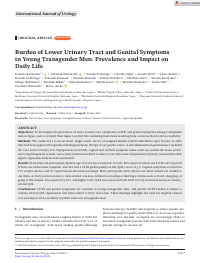
| Abstract | Objectives: To investigate the prevalence of lower urinary tract symptoms (LUTS) and genital symptoms among transgender men in Japan, and to evaluate their impact on daily life, including limitations resulting from concerns about toilet accessibility.
Methods: We conducted a cross-sectional, single-center survey of assigned-female-at-birth individuals aged 16 years or older who had been approved for gender-affirming hormone therapy at our gender center. A self-administered questionnaire included the Core Lower Urinary Tract Symptom Score (CLSS), vaginal and urethral symptom items, toilet use outside the home, preferences regarding male urinals, and activity restriction related to toilet access. Data were analyzed descriptively, and multivariable logistic regression analyses were performed. Results: Data from 322 participants (median age 33 years) were analyzed. Overall, 80% reported at least one LUTS, 46% reported at least one bothersome symptom, and 14% had a CLSS global quality-of-life (QOL) score of ≥ 4. Vaginal symptoms occurred in 13% of participants, and 2% reported post-micturition leakage. Most participants (62%) did not use male urinals but wished to use them. Activity restriction due to toilet-related concerns, defined as avoiding or limiting activities such as travel, shopping, or going to the cinema, was reported by 20%, and higher total CLSS was associated with both activity restriction and poor urinary-related QOL. Conclusions: LUTS and genital symptoms are common in young transgender men, and greater LUTS burden is linked to urinary-related QOL impairment and toilet-related activity restriction. These findings highlight the need for targeted clinical care and improved accessibility of public toilets for transgender men. |
| Keywords | lower urinary tract symptoms
transgender men
urinary-related activity restriction
vaginal symptoms
|
| Published Date | 2026-07-31
|
| Publication Title |
International Journal of Urology
|
| Volume | volume33
|
| Issue | issue8
|
| Publisher | Wiley
|
| Start Page | e70553
|
| ISSN | 0919-8172
|
| NCID | AA11042471
|
| Content Type |
Journal Article
|
| language |
English
|
| OAI-PMH Set |
岡山大学
|
| Copyright Holders | © 2026 The Author(s).
|
| File Version | publisher
|
| PubMed ID | |
| DOI | |
| Web of Science KeyUT | |
| Related Url | isVersionOf https://doi.org/10.1111/iju.70553
|
| License | http://creativecommons.org/licenses/by-nc/4.0/
|
| Citation | T. Kobayashi, T. Moriwake, Y. Tominaga, et al., “ Burden of Lower Urinary Tract and Genital Symptoms in Young Transgender Men: Prevalence and Impact on Daily Life,” International Journal of Urology 33, no. 8 (2026): e70553, https://doi.org/10.1111/iju.70553.
|